Long before Congress turned against the New Deal, the Supreme Court was challenging many of its programs: The first Agricultural Adjustment Act (AAA) of 1933, the National Industrial Recovery Act (NIRA) of 1933, the Social Security Act of 1935, the minimum wage section of the Fair Labor Standards Act, and the National Labor Relations Act of 1935 were all challenged in court. The Social Security Act was challenged three different times! The AAA and the NIRA were both found unconstitutional and shut down.
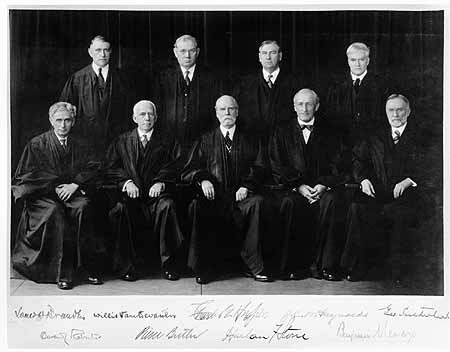 |
| The Supreme Court: FDR would do battle with these men over the New Deal in 1937. |
Even though the other programs were cleared, FDR was irritated by what he saw as the Court's hostile attitude toward his New Deal. Most of the justices on the Court had been appointed by Republican presidents, and none of them seemed ready to retire. Four of the Republican-appointed justices were particularly suspicious of New Deal legislation. They were nicknamed "the Four Horsemen" by the press, after the four riders in the Christian Bible who bring death and destruction to humankind. The Four Horsemen of the Supreme Court were trying to kill the New Deal.
How could FDR solve this problem? Read each row in the table below to find out.
| What did FDR do to try to change the Supreme Court so that it would support the New Deal? | FDR introduced a bill on his own—he did not work with any Democratic senators or congressmen—on February 5, 1937, called the Judicial Procedures Reform Bill of 1937. This bill would restructure the Supreme Court by giving the president the power to appoint a new justice to the Court whenever an existing justice turned 70 and did not retire. The Court would go from 9 justices to as many as 15. |
| How would the proposed restructuring of the Supreme Court help FDR? | In 1937, six of the Supreme Court justices were over 70—including the Four Horsemen. If the bill passed, FDR could appoint six new justices whom he knew would support the New Deal, and the Four Horsemen would be outnumbered. |
| What justification did FDR give for this change? | He said the current Court was basically too old and too small to handle its workload; cases were backing up because the justices couldn't get to them all. He never mentioned his argument with the Court over the New Deal. |
| How did Congress react? | Congress hated the bill. Members of Congress who were over 70 (and there were quite a few) were afraid that next the president would say that they had to retire, too. Most members of Congress believed the bill was unconstitutional. It gave the executive branch controlling power over the highest court of the judicial branch. The bill died in Congress before it ever came to a vote. |
Public reaction to the Judicial Procedures Reform Bill of 1937 was overwhelmingly negative. It made Americans angry and afraid that the president had gone mad with power. Even a special fireside chat about the bill on March 9, 1937, in which FDR presented it as a way to improve the Court, failed to change their minds. FDR was called a dictator and a threat to democracy itself, and his bill was referred to as the "court-packing scheme," an attempt to pack the Court with pro-New Deal justices.
Question
In his fireside chat on the court-packing bill, FDR said “the American form of government is a three-horse team... The three horses are, of course, the three branches of government--the Congress, the executive, and the courts. Two of the horses, the Congress and the executive, are pulling in unison today; the third is not.” What was he saying?
Question
FDR also said in that fireside chat, “It is perfectly clear that, as Chief Justice Hughes has said, ‘We are under a Constitution, but the Constitution is what the judges say it is.’" What did he mean?
