The Goths were a large barbarian tribe from today’s eastern Germany. The two largest groups of Goths were the Visigoths and Ostrogoths. The Goths did not pose a serious threat to the Roman Empire until the late 300s CE, when Stilicho led the effort to capture Alaric, king of the Visigoths, and his army. When Stilicho allowed Alaric to settle in Illyricum, many Goths did so, and lived amongst Romans in the province. But when the Roman Senate balked at Stilicho’s treaty with the barbarian enemy, it was the beginning of the end for the general, as you’ll see as you click the images in this slideshow.
|
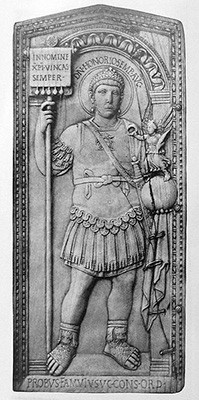
In this carving, the emperor Honorius is depicted as a victorious general, but in reality, he was a weak man who was more concerned about his own safety than about meeting the enemy in battle. Honorius relied on Stilicho to push back the barbarian threat to Rome, and seems to have trusted his general until 408. In May of that year, Honorius’ brother Theodosius, the emperor of the Eastern Empire, died, and Honorius was planning to go to Constantinople for the funeral. For some reason, Stilicho told him not to go. Perhaps he thought the emperor would be in danger of his life making the journey across Visigoth-held Illyricum. At any rate, Stilicho went in Honorius’ place, which led the emperor’s minister Olympius to conclude that Stilicho was trying to replace Honorius as emperor. Stilicho was already unpopular for his payment to Alaric, and now Olympius convinced the emperor that the general was not a loyal Roman but a barbarian at heart who planned to seize power in Rome.
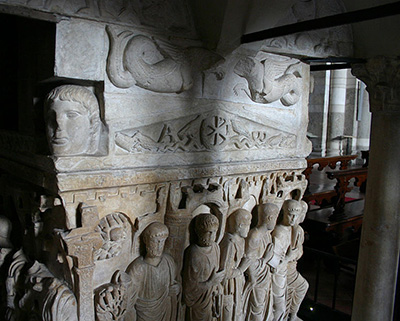
When Honorius returned to his new capital, Ravenna, he ordered the arrest and execution of Stilicho. Stilicho’s army mutinied against him in August 408, and his supporters in Ravenna were killed. Stilicho sought sanctuary in a church in Ravenna. But when soldiers came to seize him, he went quietly, and allowed himself to be publicly executed. As a powerful member of the elite, he could have used his right to defend himself in court, but he chose not to, perhaps because he feared it would lead to a civil war, as his supporters fought with the emperor’s. He was beheaded on August 22, 408, in Ravenna. The sarcophagus shown in this image is believed to be his tomb.
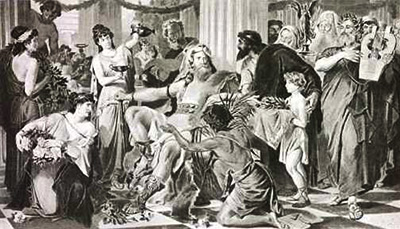
Stilicho’s death was just the beginning of a wave of anti-barbarian violence in Rome. Goth families who had been living amongst, and as, Romans were slaughtered. Historians think up to 10,000 Goths were killed, and their farms and property plundered. Those who survived the attacks, perhaps 30,000 strong, abandoned their Roman loyalties and joined Alaric’s army as it moved on Rome. Would Alaric, now a powerful ruler in his own right, finally sack the great city and bring the Western Empire to its knees? |
 |

Question
What is the likely outcome of the Goths deciding to side with their king against the Empire?
