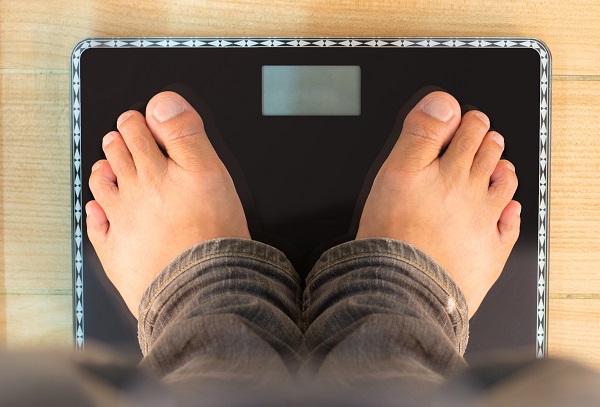
Ever stepped on a bathroom scale to measure your weight? Did you know that you can actually change the number reading by pushing down on something nearby or simply by bouncing up and down on the scale? You typically step on a scale to measure your body weight, but if the scale was truly measuring your weight, the number would not change just by pushing down on something nearby. Technically, the scale is showing you the force that it applies back up on you. When you are not moving, the force that the scale applies back up on you will equal your weight—the forces are in equilibrium. When you bounce, you are actually accelerating either up or down, causing a net force that is either up or down. The scale will adjust the reading based on these different scenarios, but your weight is not changing. The force of gravity on you is the same regardless of your acceleration, unless, of course, you decide to emigrate to another planet. Believe it or not, even going into orbit around the Earth only adjusts your weight by about ten percent—we'll get into that more specifically later.
Remember, you can always calculate an object's weight by taking its mass and multiplying by the acceleration of gravity.
Weight
\(\large\mathsf{ \overrightarrow{W} = m \overrightarrow{g} }\)
Question
An object weights 200.0 N on Earth. What would its weight be on Mars where the acceleration of gravity is 3.71 m/s2?
First, you need to find the object's mass using its weight on Earth and the acceleration of gravity on Earth:
\(\small\mathsf{ 200.0 \text{ N} = m (9.81 \text{ m/s}^2) = 123 \text{ N} }\)
\(\small\mathsf{ m = \frac{200.0 \text{ N}}{9.81 \text{ m/s}^2} = 20.387 \text{ kg} }\).
Then, use the mass in the weight equation again, but with the acceleration of gravity on Mars:
\(\small\mathsf{ \overrightarrow{W} = 20.387 \text{ kg} \cdot 3.71 \text{ m/s}^2 = 75.6 \text{ N} }\)
