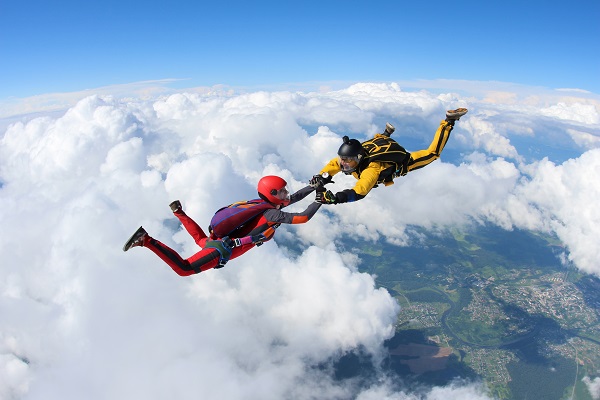
Whether it is skydiving or an object in water, there are other applications of the concepts of apparent weight than just someone standing in an elevator. In the situation with a skydiver, it's the force of air resistance that acts as the normal force. With sinking or floating, it's the buoyant force of the water pushing back up on the object that acts as the normal force. In any case, though, where there is an unbalanced scenario with the weight force, you can use the same concept. The sum of the forces in the vertical direction will equal the mass of the object times the acceleration.
Newton's First Law Application
\(\large\mathsf{ \Sigma F = \overrightarrow{F}_{\text{normal or buoyant or air resistance or ?}} + \overrightarrow{F}_{weight} = m \overrightarrow{a} }\)
Using what you know about apparent weight, see if you can solve these problems.
| Problem | Picture | Given/Find | Equation | Solution |
|---|---|---|---|---|
| A stunt woman whose mass is 49.4 kg jumps out of an airplane. At one point during her initial decent, the air resistance pushing up on her is 125.0 N. During this part of her decent, what is her acceleration? |
|
>\(\small\mathsf{ m = 49.4 \text{ kg} }\) \(\small\mathsf{ \overrightarrow{F}_{weight} = -484.6 \text{ N} }\) \(\small\mathsf{ \overrightarrow{F}_{air} = 125.0 \text{ N} }\) \(\small\mathsf{ \overrightarrow{a} = ? \text{ m/s}^2 }\) |
\(\small\mathsf{ F_{net} = m \overrightarrow{a} = \overrightarrow{F}_{air} + \overrightarrow{F}_{weight} }\) |
\(\small\mathsf{ F_{net} = 125.0 + -484.6
\text{ N} = -359.6 \text{ N} }\) \(\small\mathsf{ -359.6 \text{ N} = (49.4 \text{ kg}) \overrightarrow{a} }\) \(\small\mathsf{\overrightarrow{a} = \frac{-359.6 \text{ N}}{49.4 \text{ kg}} = -7.28 \text{ m/s}^2 }\) |
| A stunt woman whose mass is 49.4 kg jumps out of an airplane. After falling for a few seconds, the air resistance pushing up on her is 485.6 N. During this part of her decent, what is her acceleration? |
|
\(\small\mathsf{ m = 49.4 \text{ kg} }\) \(\small\mathsf{ \overrightarrow{F}_{weight} = -484.6 \text{ N} }\) \(\small\mathsf{ \overrightarrow{F}_{air} = 484.6 \text{ N} }\) \(\small\mathsf{ \overrightarrow{a} = ? \text{ m/s}^2 }\) |
\(\small\mathsf{ F_{net} = m \overrightarrow{a} = \overrightarrow{F}_{normal} + \overrightarrow{F}_{weight} }\) |
\(\small\mathsf{ F_{net} = 484.6 + -484.6
\text{ N} = 0 \text{ N} }\) \(\small\mathsf{ 0 \text{ N} = (49.4 \text{ kg}) \overrightarrow{a} }\) \(\small\mathsf{\overrightarrow{a} = \frac{0 \text{ N}}{49.4 \text{ kg}} = 0 \text{ m/s}^2 }\) |
| A stunt woman whose mass is 49.4 kg jumps out of an airplane. She reaches a point during her fall where she must pull open her parachute. Once the parachute if fully deployed, it exerts an upward force of 868.8 N. During this part of her decent, what is her acceleration? |
|
\(\small\mathsf{ m = 49.4 \text{ kg} }\) \(\small\mathsf{ \overrightarrow{F}_{weight} = -484.6 \text{ N} }\) \(\small\mathsf{ \overrightarrow{F}_{air} = 868.8 \text{ N} }\) \(\small\mathsf{ \overrightarrow{a} = ? \text{ m/s}^2 }\) |
\(\small\mathsf{ F_{net} = m \overrightarrow{a} = \overrightarrow{F}_{normal} + \overrightarrow{F}_{weight} }\) |
\(\small\mathsf{ F_{net} = 868.8 + -484.6
\text{ N} = 384.2 \text{ N} }\) \(\small\mathsf{ 384.2 \text{ N} = (49.4 \text{ kg}) \overrightarrow{a} }\) \(\small\mathsf{\overrightarrow{a} = \frac{384.2 \text{ N}}{49.4 \text{ kg}} = 7.78 \text{ m/s}^2 }\) |