The American public might think that FDR was in total charge of the economy and that his actions alone made it rise or fall, but FDR thought differently. On Halloween night in 1936, during his presidential campaign, FDR gave a speech at Madison Square Garden in New York City in which he made these assertions:
For nearly four years you have had an Administration which instead of twirling its thumbs has rolled up its sleeves. We will keep our sleeves rolled up. We [have] to struggle with the old enemies of peace: business and financial monopoly, speculation, reckless banking... We know now that Government by organized money is just as dangerous as Government by organized mob. Never before in all our history have these forces been so united against one candidate as they stand today. They are unanimous in their hate for me—and I welcome their hatred. I should like to have it said of my first Administration that in it the forces of selfishness and of lust for power met their match, [and] I should like to have it said of my second Administration that in it these forces have met their master.
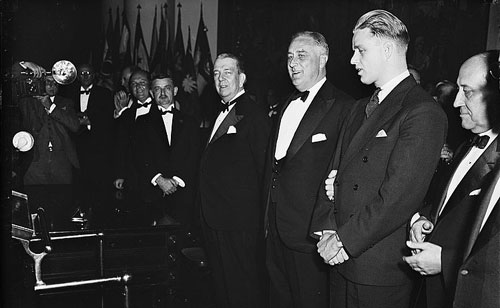
Why was FDR inviting big business to "bring it"? Because he blamed big business for the Recession. America's top businessmen, said FDR, represented nothing but "business and financial monopoly, speculation, [and] reckless banking," and were on the same moral level as organized criminals (the "mob") who made their money by cheating and stealing from the American people. FDR may have attended big business conventions like the bankers' convention he is shown at in this photo, but he did not trust big businessmen. To FDR, they would always be more interested in their own wealth than in the nation's economic security. So even as he pushed through more New Deal programs, FDR tried to focus public blame for the Recession on big business.
How did big business respond? What happened then? Find out by reading each row in this table.
| Big Business Responds | How did manufacturing, banking, and other industries respond to FDR's accusations? They put the blame for the Recession back on him. They said they had been hurt by New Deal programs of 1935-1937 that gave more rights to workers and labor unions. They protested against the FLSA, which established a minimum wage, guaranteed overtime pay, and put a limit on the work week. They blamed FDR for creating temporary, federally funded jobs instead of long-term, big business jobs. |
| FDR Strikes Back | FDR responded by accusing big business of deliberately slowing production to create a recession so that voters would vote Democrats out of office in the 1938 Congressional elections (FDR was a Democrat). He called it a "capital strike" (a strike called by men who produced capital, or money) and asked the FBI to investigate it as a crime. |
| The FBI Investigation | Did the FBI find evidence of a criminal conspiracy by big business? No. FDR was forced to give up on the conspiracy theory. Instead, he attacked the "Sixty Families" (the equivalent of today's "1 percent" richest Americans), saying they were an oligarchy—an undemocratic government for the super-rich that was fighting the federal government's attempts to help the poor and unemployed. |
| Public Reaction | Did the public buy FDR's accusations against big business? Not really. After four years of witnessing the federal government wield great power to create the New Deal, people were skeptical that the "Sixty Families" could really stand in its way. And the majority of Americans believed in the "American dream" and therefore believed that anyone who became rich as a result of their work deserved to be rich. They weren't going to get rid of the 1 percent because they hoped to join it someday! |
FDR's attempt to shift the blame for the Recession onto big business failed. In 1939 a poll was taken that asked, "Do you think the attitude of the Roosevelt administration toward business is delaying business recovery?" More than two-thirds of people who responded said "yes." Americans still believed in big business and still blamed FDR for the Recession.
Question
Why would FDR attack big business when he needed the manufacturing and banking industries to grow?
