The last thing Americans expected as FDR began his second term was that the Depression would get sharply worse. Why should it? Big business profits were back up to pre-Crash levels, and unemployment was easing. With New Deal programs in place to stabilize the economy, a downturn should have been impossible. But that’s exactly what happened just weeks after FDR’s re-election.
Economists today aren’t sure what went wrong. It could be that the economic reforms FDR put in place in his first term hadn’t fully taken effect yet; it could be that going off the gold standard and printing more dollars hurt the economy; or it could have been just a normal part of the business cycle, which always goes up and down. All three could have worked together to cause the problem. But whatever the reason, the economy began to sink in the spring of 1937 into the Recession of 1937-1938, a 13-month economic slowdown that had people panicking--and blaming FDR.
Manufacturing fell by nearly 30 percent, business profits fell, and unemployment rose from 14 percent to 19 percent. Americans who believed that FDR was responsible for the economic recovery of 1933-1936 now believed that FDR was also responsible for the economic downturn.
Learn how FDR responded to the Recession of 1937-1938 by clicking through these tabs.
Bring Back Federal Spending!
The Housing Act
The Agricultural Adjustment Act
The Fair Labor Standards Act
FDR had cut government spending early in 1937. It was part of his attempt to bring down the deficit. His administration had not introduced a major New Deal program since Social Security in 1935. Many people blamed the cuts for causing the Recession. Picture a bicycle with training wheels: Little kids learning to ride need those wheels to catch them if they start to fall over. Federally funded New Deal programs were the training wheels on the U.S. economy. Taking away those training wheels too soon, before the economy could grow on its own, was a mistake. So the Roosevelt Administration put forward new government spending programs--additions to the New Deal--hoping they would jump-start a recovery.
 |
| Did FDR take the training wheels off the U.S. economy too soon? |
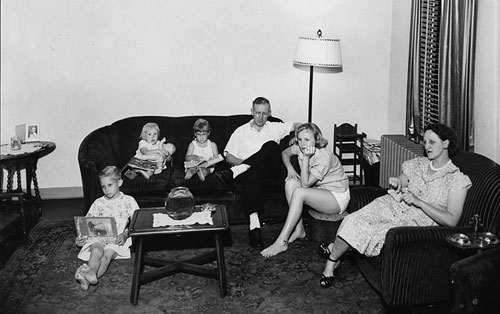
The Housing Act of 1937 (also known as the Wagner-Steagall Act) used federal money to build affordable housing for low-income families living in dirty big-city apartments and rural farmers' shacks. The family in this photo is enjoying their new apartment in an Atlanta, Georgia, housing unit. The Housing Act of 1937 led to the creation of the U.S. Housing Authority in the Department of the Interior, which is known today as the Department of Housing and Urban Development (HUD).
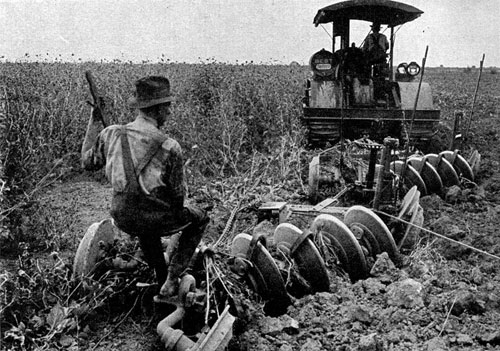
The Agricultural Adjustment Act (AAA) of 1938 replaced another one of the same name that had been passed in 1933 but was later found unconstitutional. The 1938 Act paid farmers not to plant part of their land so that there would not be overproduction of food (which drove down prices and drove farmers into bankruptcy). It also offered federal price supports for corn, cotton, and wheat--that is, the federal government would make sure that the price paid for each of these crops did not drop.
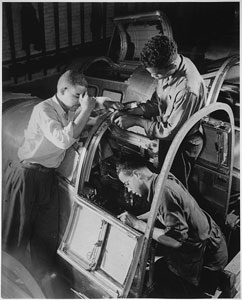 The Fair Labor Standards Act of 1938 (the FLSA) was far-reaching: It established a national minimum wage, limited the work week to 44 hours and seven days maximum, and outlawed most child labor. In addition, the FLSA guaranteed workers who worked overtime "time and a half" pay, which was their regular hourly wage plus one half--if the factory workers in this photo got $5 an hour for regular time, they would get $7.50 for overtime. Why would this help the economy?

By limiting the number of hours workers could work, the Act made it necessary for many companies to hire more workers to cover the hours they now had to take away from their existing workers. By taking children out of the workforce, it forced companies to hire adult workers, who had to be paid more than children. This way, workers would have more money to buy housing, food, and other necessities. The minimum wage and overtime pay also gave workers more money to spend, to grow the economy.
Along with creating new New Deal programs, FDR also asked Congress for $5 billion more to expand current New Deal programs, especially the popular Works Progress Administration, which provided temporary jobs to millions of Americans. He got the $5 billion, and created over 3 million new WPA jobs.
Answer these questions to hone your understanding of FDR's successful second-term New Deal programs.
Would these new New Deal programs turn around the Recession of 1937-1938 quickly, or were they more long-term solutions?
How could FDR get more federal spending approved during a severe recession?
| Your Responses | Sample Answers |
|---|---|
| They were mostly meant to have an immediate impact: Under the FLSA, workers immediately got more money, and more workers would be hired. Under the AAA, farmers would see immediate price stabilization for their crops. Only the Housing Act would take a while, as the affordable housing units would have to be built. | |
| Americans believed that cutting back on federal spending and slowing down the New Deal had caused the Recession. Congress did not want to argue with them and was willing to spend more money to end that Recession. |
