Over several decades, Rome gradually lost control of its western provinces. The Empire was in full crisis as Barbarians--tribes from the area to the north of Rome known as Barbary--threatened to invade the city itself. By this point deep financial pressures prevented Rome from keeping its military strong or repairing its crumbling infrastructure. Furthermore, the Empire had split into Eastern and Western sections, and the Empire in the East--not Rome--was the stronger and wealthier of the two.
Western Rome’s top general, a half-barbarian named Stilicho, attempted to keep the Western empire alive, but he had few options: His army was crumbling, the emperor, Honorius, was weak, and the pagans were advancing. The stage was set for a massacre.
Read these tabs to learn how Stilicho attempted to protect Rome against all odds.
Stilicho, the Half-Blood General
Doing a Deal with the Enemy
Hero or Traitor?
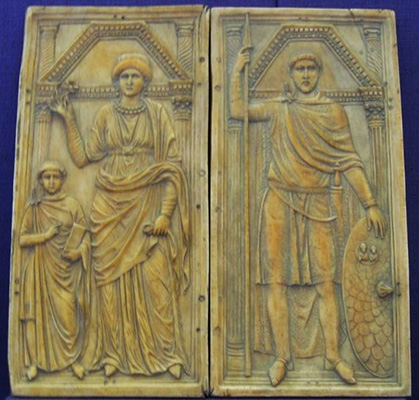
By Photographed by User:Bullenwächter [GFDL (www.gnu.org/copyleft/fdl.html) or CC-BY-SA-3.0 (http://creativecommons.org/licenses/by-sa/3.0/)], via Wikimedia Commons
Stilicho was born in 359 CE, the son of a Vandal soldier (the Vandals were an eastern German tribe) and a Roman woman. He considered himself a Roman and married the niece of the emperor Theodosius. Stilicho even served as emperor when the heir, Honorius, came to the throne as an underage child. Once Honorius took power himself, Stilicho served him by leading a Roman army against barbarians, particularly the Visigoths, who were led by their king, Alaric. (The Visigoths were another Germanic tribe.)
What was unusual about Stilicho?

He was part-barbarian himself but identified himself as a Roman and was accepted by the highest levels of Roman society. He even led the fight against barbarian invasion.
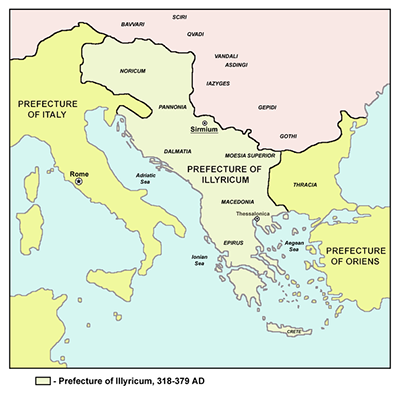
By PANONIAN at en.wikipedia Later version(s) were uploaded by Megistias at en.wikipedia. [Public domain], from Wikimedia Commons
In 397, Stilicho defeated Alaric's forces in Macedonia, but failed to capture Alaric, who continued to threaten Rome and besieged the emperor Honorius in Milan. Stilicho saved the emperor and defeated Alaric in 402, but again Alaric himself escaped capture. Honorius, panicked, moved his capital from Rome to the eastern Italian city of Ravenna, which he thought would be safe from attack. At last in 406 Stilicho signed a truce with Alaric, putting him in charge of Illyricum, the region of the Western empire that lay just east of Italy.
Why did Stilicho make Alaric the military governor of Illyricum, a Roman province?
Historians think that Stilicho needed Alaric’s men to replace his dwindling Roman army. Rome still faced threats from the Vandals and other barbarian groups, but its army was being decimated by constant fighting. If Rome could ally with the Visigoths, it would have a new army to fight with.
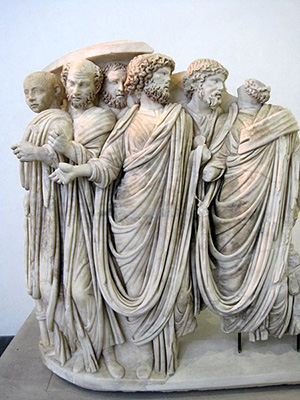
See page for author [CC-BY-SA-3.0 (http://creativecommons.org/licenses/by-sa/3.0) or GFDL (http://www.gnu.org/copyleft/fdl.html)], via Wikimedia Commons
Stilicho had not yet convinced Alaric’s Visigoths to fight with him when a rebellion in the northern province of Gaul (today’s France) forced him to fight another battle against barbarian invasion on his own. Even when Alaric threatened to attack Italy again if he was not given a large payment in gold that he was owed, Stilicho must have hoped to ally with the Visigoths at some point because he convinced the Roman Senate to make the payment. This angered many elite Romans, who said Stilicho had made them slaves of the barbarians.
What suspicion might these Roman senators have begun to entertain about Stilicho?
That he was actually more barbarian than Roman, and wanted to ally with the Visigoths to sack Rome and plunder it, not to save it.
Question
Why did Stilicho, a Roman general, want an alliance with the Visigoths?
