In 800 CE, the Frankish King Charlemagne was crowned by the Christian Pope--not just as king of Frankland, but as emperor of the Holy Roman Empire. The Roman Catholic Church, which had gained power and wealth even as Rome fell, wanted a new empire that answered to the Church and helped to spread its influence. Through military conquests, Charlemagne expanded this new empire to incorporate much of western and central Europe.
What effect did Emperor Charlemagne have on Europe? Read more in these tabs.
Emperor Charlemagne
The Holy Roman Empire
Moving Into the Light
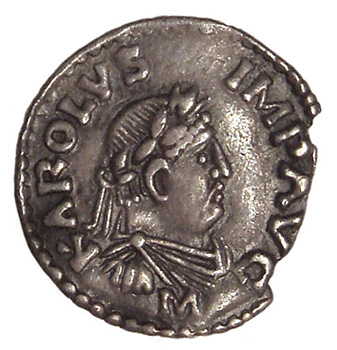
By PHGCOM [CC-BY-SA-3.0 (http://creativecommons.org/licenses/by-sa/3.0) or GFDL (http://www.gnu.org/copyleft/fdl.html)], via Wikimedia Commons
On Christmas Day, 800 CE, Carolus, king of the Franks, was crowned Emperor Charlemagne by the pope at St. Peter’s Basilica in Rome. Charlemagne is from the Old French for Charles the Great. This coin, minted during his reign, shows Charlemagne as a Roman emperor, with the Roman name Emperor Charles Augustus, wearing a toga and with a laurel wreath of victory in his hair.
Why would Charlemagne want to associate himself with the Roman Empire?

He wanted to send a message that he had the power and the lands of a great Roman emperor, that he could create a civilization as great as Rome, and that he should be obeyed like an emperor.
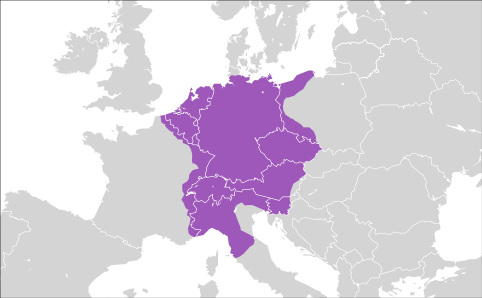
By Ssolbergj (Own work, based on File:Holyromanempire.png) [CC-BY-SA-3.0 (http://creativecommons.org/licenses/by-sa/3.0) or GFDL (http://www.gnu.org/copyleft/fdl.html)], via Wikimedia Commons
Charlemagne’s kingdom included all or part of today’s countries of France, Germany, Belgium, Switzerland, Poland, Czech Republic, Slovakia, Austria, and Italy. No ruler in Europe since the western Roman emperors had controlled more land. Like those emperors, Charlemagne won his empire through conquest, and united his diverse lands with a code of law, a currency, and an education system.
What did being part of an empire again mean for the people Charlemagne ruled?
They were once again encouraged to produce goods for trade, use money, and send their sons to school to be educated. They could depend on Charlemagne for military protection as long as they obeyed his rule.
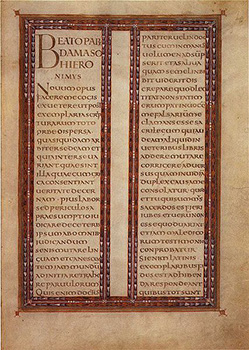
Charlemagne’s empire had to be built from scratch—it could not measure up to the grandeur of Rome. It had few cities and little trade, in part because there were few good roads left over from Roman times. But Charlemagne encouraged building and road-making, and he also did what he could to ensure his legacy. Under his rule efforts to reform and create a universal script for writing came together in a standard form of clear, easy-to-learn handwriting that remained in use for centuries, shown here in an early gospel.
Why would Charlemagne care about standardizing handwriting?
Everything was handwritten in his time: laws, religious texts, royal decrees, and histories. Charlemagne wanted his officials to create records that anyone could read, so that his laws and achievements would be preserved and used long after his death.
Question
Why was Charlemagne's kingdom called the Holy Roman Empire?
