Your Environment
What types of things make up your environment?
Goal:
Goal:
|
Your environment is made up of all the things around you. The word environment came from the Greek language. In Greek, "environs" means "surrounding." In the picture, the boy's environment at the moment is his bed, the sheets, the flashlight, the air, the amount of heat, and everything else in his bedroom.
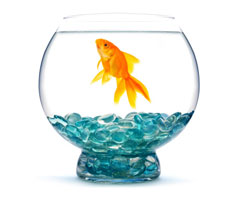
Do you have a pet fish? If you do, everything in the fishbowl is part of the fish's environment. A clear glass fishbowl makes the fish's environment easy to see: the water, the air bubbles, the air pump, the sand, gravel, rocks, food, plants, the underwater thermometer, and maybe a tiny treasure chest are all parts of the fish's immediate environment. In fact, if the fish can see out of the bowl, and the temperature and light in the bowl are in any way affected by the atmosphere in the room the bowl is in—these things are also part of the fish's larger environment.
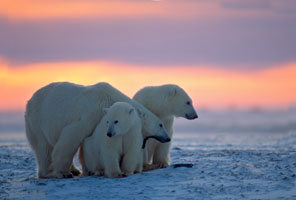
There are many different kinds of environments. A forest is a very different type of environment from a desert or the environment at the bottom of the ocean. Different environments are also different sizes: your room, the fishbowl, a city, a forest, a country, or a continent. Even the entire planet Earth can be viewed as one big environment.
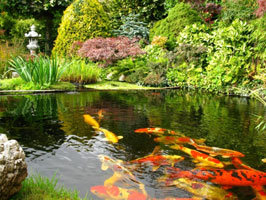
All of these environments have certain things in common: each is made up of living things and nonliving things. In the first part of this lesson you learned the essential characteristics of living things. In a pond, you might find living things like fish, frogs, plants, and various types of mosses, algae, and bacteria. Some of the nonliving things in a pond would be water, mud, rocks, and sunlight.
Scientists have a few specific words to describe living and nonliving things. Living things are called biotic. Nonliving things are called abiotic. Just as with the word environment, these terms also come from Greek. Biotic comes from the Greek word, "biotikos," which means "related to life." You'll see the root word -bio often—it means "life." Adding the "a" before "biotic" makes a word that means "without life." Can you spot three living things and three nonliving things in the picture?
|
 |