Listening to music and reading a poem are different experiences, of course. When you read a poem, you have to listen for the rhythm created by the words themselves. You can also look for repeated lines and ideas that might help you figure out what experience the poem explores. It might be a "big" experience, like thinking back to the years of childhood. Or it might be an everyday experience, like meeting someone new. Poems can even explore a very ordinary experience, such as doing your chores.
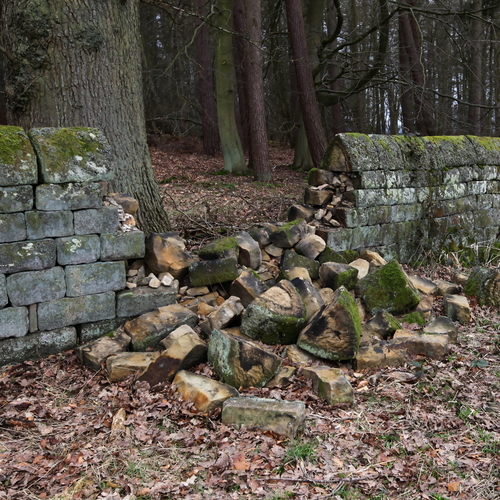
In fact, a regular chore is the focus of Robert Frost's classic poem "Mending Wall." In this poem, the speaker walks alongside a stone wall that needs repairing. Take a look at the photo below.

Did you notice that there's nothing to hold the stones in place—no cement or mortar? People build "dry" stone walls by carefully stacking the stones. Gravity and friction hold the wall together. However, when the ground beneath the wall freezes in winter and then thaws in spring, some of the stones shift out of place, causing gaps and fallen sections. Every year, someone must go out to mend the wall, or it will soon become just a long pile of stones.
As you read and listen to "Mending Wall," imagine what the poem's speaker sees as he inspects and fixes a stone wall in springtime.
In "Mending Wall," the speaker isn't necessarily the poet, Robert Frost. The speaker may be a persona—a fictional character created for the poem. Still, he's someone you can get to know if you pay attention to the words he uses and the imagery his words create. What kind of person does he seem like, based on his words? Read each set of lines below and decide what the lines tell you about the speaker of the poem. Then click the passage to compare your thoughts to a sample answer.
The speaker seems to be a playful and imaginative person. He turns the chore of fixing the wall into a "kind of out-door game" and uses imagery to compare the rocks to "loaves" of bread and to "balls" someone could play with. |
|
The speaker views the world with a sense of humor. He tries to get his neighbor to picture apple trees tromping across the meadow to eat pine cones. |
|
The speaker imagines unknown and unseen forces in his world. He wonders twice what it is that "doesn't love a wall, / That wants it down." He tries to get his neighbor to see the world in an imaginative, wondering way, too. |
|
The speaker is also aware that the world is not just a pretty place. It has shadows and fearfulness. When his neighbor refuses to think about whether they need a wall, the speaker uses imagery to describe the neighbor as someone stuck in the dark, unwilling to step into the light. |
Question
The poet's word choice creates different kinds of imagery. What does it all add up to? Make a guess at the theme this imagery suggests.
