If you have an important idea to share, you will probably choose your words carefully. Poets do, too. The words they choose will create the poem's tone and help reveal its theme. And because poems are often brief, every word choice counts! For this reason, poets choose words that bring associations to readers' minds—feelings, ideas, memories, and even historical and cultural connections. Or the words may have figurative meanings that go beyond their literal meanings. These associations are a word's connotations.
When you look up a word in a dictionary, you learn its denotation—its basic meaning. When you think about all the ways a word is used, on the other hand, and all the ideas and feelings it might bring to your mind, you are thinking about its connotations. Even a simple word like "wall" has connotations, as Robert Frost knew well when he wrote "Mending Wall."
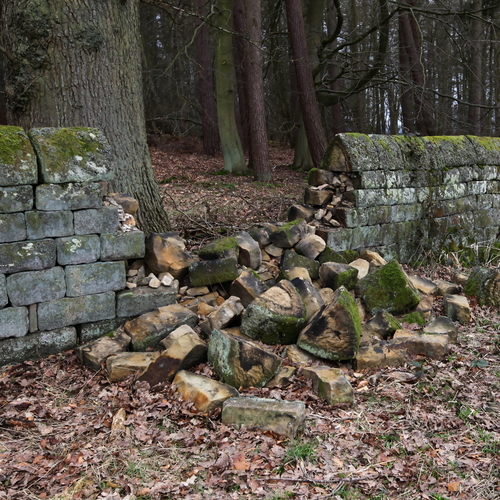
Poets often use words with connotations that make readers think about layers of meaning. What words in "Mending Wall" have figurative as well as literal meanings? How does each word's connotation help you understand what matters to the speaker? Use the activity below to take a closer look at some of Robert Frost's word choices. Read each question carefully and write your own answer. Then, at the end of the activity, compare your answers to the samples.
Mending Wall
Something there is that doesn't love a wall,
That sends the frozen-ground-swell under it,
And spills the upper boulders in the sun;
And makes gaps even two can pass abreast.
The work of hunters is another thing:
I have come after them and made repair
Where they have left not one stone on a stone,
But they would have the rabbit out of hiding,
To please the yelping dogs. The gaps I mean,
No one has seen them made or heard them made,
But at spring mending-time we find them there.
I let my neighbor know beyond the hill;
And on a day we meet to walk the line
And set the wall between us once again.
We keep the wall between us as we go.
To each the boulders that have fallen to each.
And some are loaves and some so nearly balls
We have to use a spell to make them balance:
‘Stay where you are until our backs are turned!'
We wear our fingers rough with handling them.
Oh, just another kind of out-door game,
One on a side. It comes to little more:
There where it is we do not need the wall:
He is all pine and I am apple orchard.
My apple trees will never get across
And eat the cones under his pines, I tell him.
He only says, ‘Good fences make good neighbors.'
Spring is the mischief in me, and I wonder
If I could put a notion in his head:
‘Why
do they make good neighbors? Isn't it
Where there are cows? But here there are no cows.
Before I built a wall I'd ask to know
What I was walling in or walling out,
And to whom I was like to give offense.
Something there is that doesn't love a wall,
That wants it down.' I could say ‘Elves' to him,
But it's not elves exactly, and I'd rather
He said it for himself. I see him there
Bringing a stone grasped firmly by the top
In each hand, like an old-stone savage armed.
He moves in darkness as it seems to me,
Not of woods only and the shade of trees.
He will not go behind his father's saying,
And he likes having thought of it so well
He says again, ‘Good fences make good neighbors.'
Robert Frost
Most dictionaries will tell you the literal meaning of a word, but many words have figurative meanings as well. What does the word wall often mean, besides its literal meaning? What connotations does the word have—positive or negative?
A dictionary will tell you that a "gap" is a hole where it's not supposed to be—an unfilled space. The wall the speaker and his neighbor are fixing has literal gaps. In the poem "Mending Wall," what other ideas might the word gap suggest?
Spell is an interesting word to use in this poem. It usually appears in fantasy stories and describes spoken words that change the world in some way. But this poem has no magicians—it's set in the real world. What connotations come along with the word spell when it's used in a realistic poem?
| Your Responses | Sample Answers |
|---|---|
A figurative wall might be an emotional barrier between two people, such as fear or disagreement, or it might be something that separates a person from their own feelings or memories. These uses of wall generally have negative connotations. |
|
A literal gap in a wall might be a hole that needs repair, but it might also be a way through a real wall that's keeping someone out of a place they want to be in. It might be a way through a problem someone needs to solve. These meanings of gap have positive connotations. |
|
The connotations of spell can add a touch of mystery or wonder to everyday situations. A spell can't quite be explained or understood. Maybe it can't be resisted, either. This could be a positive connotation that suggests something wondrous. But it could carry a negative connotation if the spell is more like a curse. The poem does take a dark turn in its closing lines. |
|
