 As you may have learned in an earlier lesson, John Winthrop and other New England governors treated each colony like a theocracy, a society ruled by religious leaders who enforce religious laws. Under Winthrop's strict guidance, the Massachusetts Bay Colony thrived, and most Puritans seemed content to have their personal lives controlled in this manner. However, a few individuals spoke out against Winthrop and the very powerful Puritan church.
One such dissenter was a woman named Anne Hutchinson. She felt that Winthrop was too legalistic in his approach to spirituality, emphasizing obedience to religious laws over faith in God. Influential and charismatic, Hutchinson not only introduced ideas that conflicted with the doctrine of the church but also managed to convince most of Boston that she was right and the ministers were wrong.
Essentially, Hutchinson argued that God selected who he wanted to save; therefore, being saved could not be "earned" by living a pious life (following the strict laws of the colony) and doing good works. Hutchinson also promoted the idea that once you were saved, you were controlled by God and no longer bound by the laws of the church and its clergy. These were men, after all, who may not have been part of God's chosen "elect."
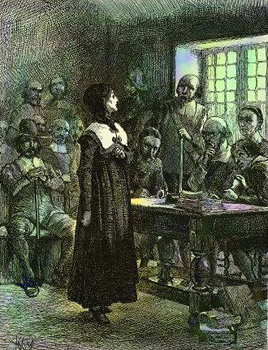
Anne Hutchinson's ideas seemed so dangerous to those in power that eventually they tried her for heresy—a very serious crime in those times because it suggested that the defendant, in holding beliefs contrary to religious teaching, was motivated by evil forces. As a result of the trial, Hutchinson was publicly chastised, banished from the colony, and excommunicated from the church. This was a stiff sentence, indeed, in a land still as wild and "unsettled" as New England.
In a brief note, the editor who first published John Winthrop's A History of New England explained the specific beliefs Anne Hutchinson held and shared freely with others. As you read the editor's note below, think about why Anne Hutchinson's ideas were so controversial and why the consequences she received were so harsh.
Here begins the story of a most painful and memorable episode of our history. No other chapter of Massachusetts history is so full of perplexities. Mrs. Hutchinson came from Lincolnshire to America, with her husband, a worthy but not notable man, and their children, drawn to America through her admiration for John Cotton, whose ministration while he was rector of St. Botolph's Church she had much enjoyed. She was a woman of kind heart and practical capacity of various kinds, possessed, too, of a fervent spirit and an intellect so keen that she was held to be the "masterpiece of woman's wit" (Johnson, Wonder-Working Providence, book I., ch. 42.)
[Hutchinson] attained great influence among the women of the settlement, which soon extended to the men as well; and when she denounced the ministers of the colony. . . , she carried with her the Boston church, hardly any but Winthrop and Wilson the pastor withstanding her. Since the other churches of the settlement took opposite ground, a quarrel arose very bitter and dangerous, the details of which may be best learned from Winthrop.
The ecclesiastical dispute as to justification by faith and justification by works is as old as the apostles Paul and James. Mrs. Hutchinson's idea was that saving grace went only to such as possessed faith, and that, this grace having been received, the recipient was above law. Hence the term "antinomian" was hurled at her and her sympathizers, a term expressly repudiated by Wheelwright, and certainly unwarranted; for the Hutchinsonians, while scorning "legalism," did not mean to cut loose from moral obligations.
Undoubtedly, however, there was danger that in minds confused with the controversial jargon, Mrs. Hutchinson's ideas might be taken as countenancing licentiousness, and in one memorable case, that of John Underhill, hereafter narrated, they certainly were taken as a cloak for loose living.
Question
Why did Governor Winthrop and the ministers of the Massachusetts Bay Colony find Anne Hutchinson's ideas so dangerous that she needed to be ousted from the colony and the church?
