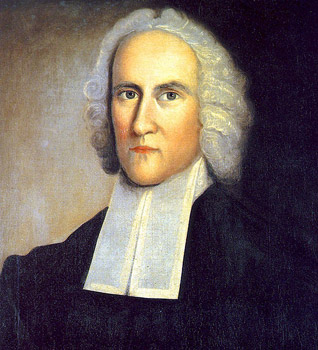
 A century after John Winthrop's death, Jonathan Edwards rose to power in New England's colonies. Unlike Winthrop, though, Edwards influenced Puritan thought through his place in the pulpit—not through any government position. The Puritan minister was a major figure in the Great Awakening, a spiritual movement that spread across the colonies through large religious meetings called "revivals." The goal of a Puritan revival was to "save" sinners who hadn't been "born again through Christ."
At one such gathering, Edwards delivered his most famous sermon, "Sinners in the Hands of an Angry God." The spiritual leaders of John Winthrop's era tended to read sermons of "reason" to their congregations, calmly and without much outward show of feelings. However, Jonathan Edwards and other preachers of the 1700s tried to move listeners not by reasoned argument but through fiery, highly emotional speeches.
Use the slides below to read more about Jonathan Edwards and his impact on Puritan beliefs.
|
Born in 1703 to a prominent Connecticut minister, Jonathan Edwards received an excellent education as a child. Fascinated by science and the natural world (he was especially intrigued by the achievements of Sir Isaac Newton), Edwards graduated from Yale as valedictorian of his class. While many intellectuals during the Age of Enlightenment began to see scientific discoveries as evidence that discredited the mysteries of religion, Edwards viewed science as further proof of God's power. Edwards was deeply religious and was ordained as a minister after graduating from college. He assisted his grandfather, Reverend Solomon Stoddard, with his congregation until Stoddard's death in 1729. At that point, young Edwards had to lead the massive congregation on his own.
In the 1730s, Jonathan Edwards and others began preaching to large audiences at revivals across the colonies. Because life in the colonies had grown easier and more comfortable since the first Puritans arrived in the 1600s, many religious leaders felt colonists had become less pious and even spiritually reckless. Edwards urged his listeners to remember that God was all-powerful and that only through God would humans be saved from damnation. As religious fervor at his revivals spread, many listeners responded to Edwards' sermons by crying out, having fits, or even losing consciousness. Records show that some listeners were so overcome by shame and guilt during Edwards' sermons that they committed suicide. More conservative religious leaders had trouble with Jonathan Edwards's zeal and were concerned about people's responses to it.
As Edwards aged, his own congregation began to question his methods. Some feared that he had become a fanatic, despite his great popularity throughout the colonies. When Edwards publicly accused many young churchgoers of reading improper books, the angry congregation finally fired Edwards. He continued to preach by doing missionary work with Native Americans and later became president of the College of New Jersey, now Princeton University. Shortly after taking the position in 1758, Edwards died from a smallpox inoculation. Although his own congregation had rejected his new ideas, Edwards died a very respected man who had forever altered the religious mindset of New England. |
 |




Question
What was new about Jonathan Edwards's brand of Puritanism?
