In his essays, Emerson expresses some complex ideas about the nature of the world and the human spirit. To illustrate these ideas and help readers understand what he wants to say, Emerson often uses examples, imagery, and figurative comparisons such as metaphor and personification.
Read this passage from Emerson's long essay titled Nature.
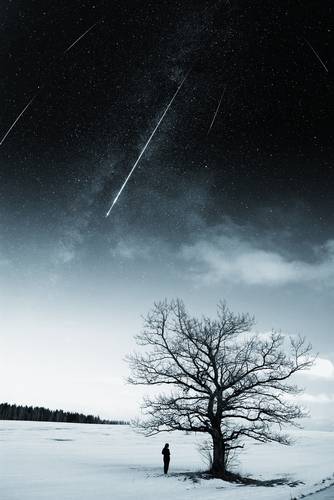 To go into solitude, a man needs to retire as much from his chamber as from society. I am not solitary whilst I read and write, though nobody is with me. But if a man would be alone, let him look at the stars. The rays that come from those heavenly worlds, will separate between him and what he touches. One might think the atmosphere was made transparent with this design, to give man, in the heavenly bodies, the perpetual presence of the sublime. Seen in the streets of cities, how great they are! If the stars should appear one night in a thousand years, how would men believe and adore; and preserve for many generations the remembrance of the city of God which had been shown! But every night come out these envoys of beauty, and light the universe with their admonishing smile.
The stars awaken a certain reverence, because though always present, they are inaccessible; but all natural objects make a kindred impression, when the mind is open to their influence. Nature never wears a mean appearance. Neither does the wisest man extort her secret, and lose his curiosity by finding out all her perfection. Nature never became a toy to a wise spirit. The flowers, the animals, the mountains, reflected the wisdom of his best hour, as much as they had delighted the simplicity of his childhood.
...
Yet it is certain that the power to produce this delight, does not reside in nature, but in man, or in a harmony of both. It is necessary to use these pleasures with great temperance. For, nature is not always tricked in holiday attire, but the same scene which yesterday breathed perfume and glittered as for the frolic of the nymphs, is overspread with melancholy today. Nature always wears the colors of the spirit. To a man laboring under calamity, the heat of his own fire hath sadness in it. Then, there is a kind of contempt of the landscape felt by him who has just lost by death a dear friend. The sky is less grand as it shuts down over less worth in the population.
To get at Emerson's complicated ideas about nature and its effect on the human spirit, try answering these two questions.
| How does Emerson personify nature in this passage? What kind of "person" is nature in relation to human observers? | Emerson personifies nature as a wise, mysterious, ever-changing presence that responds to the observer's moods and feelings. |
| According to Emerson, what determines the mood represented by a natural landscape? | the mood of the human observer, based on their recent experiences or current emotional state |
