Loading...

Representing Fractions with Models

How do you represent fractions with models?

Goal:

Goal:

Using models to represent division can give you a better idea of what is happening in your problem; the models give us a picture of the division. Let’s take a closer look at how to create a model of a division expression.

Getting Started!

Let's think about the fraction \(\mathsf{ \frac{3}{2} }\), which is the same as the division expression 3 ÷ 2. What would the model of this problem look like? First we draw a model of 3 items, as shown below. 

We'll use squares to start:
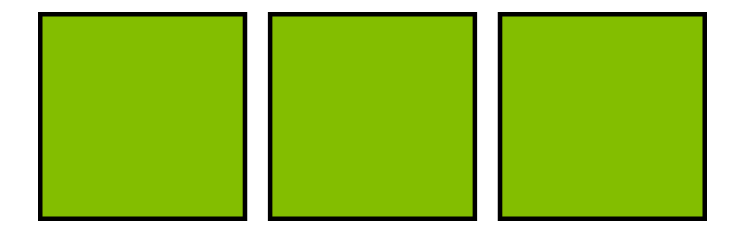
Three green squares next to one another.

Then What?

If we want to divide the 3 squares equally into 2 parts, what would that look like? 
How much would be in each part? 
Draw your own picture, then click the Answer button to see how it compares.

Finish It Up!

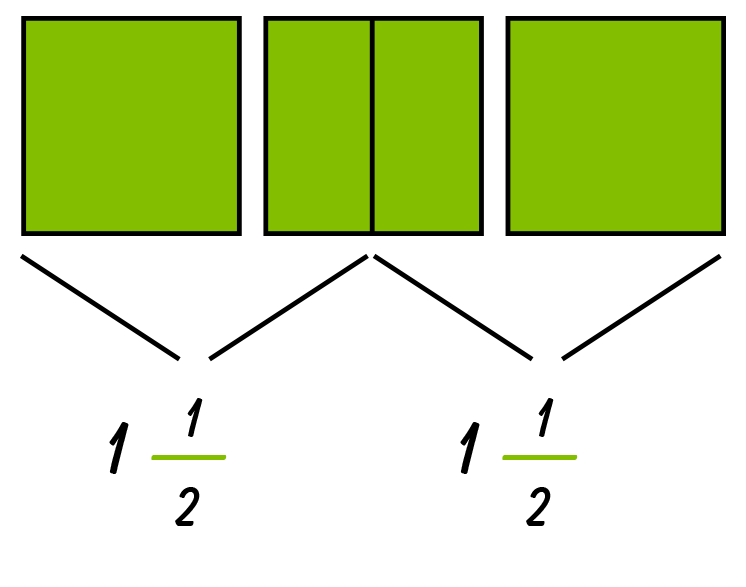
Three green squares next to one another. The middle square is divided into two halfs. Lines pointing to squares representing one and one half. You can see that if you divide 3 by 2, you will have \(\mathsf{ 1\frac{1}{2} }\) in each group. So, \(\mathsf{3 \div 2 = 1\frac{1}{2} }\).