Loading...

Family of Quadrilaterals

How are the different types of quadrilaterals related?

Goal:

Goal:

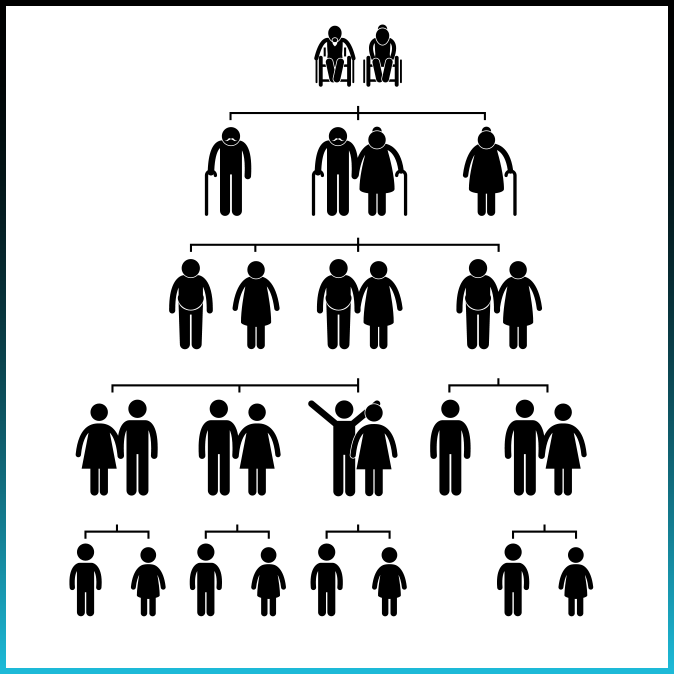
Family Tree Genealogy Diagram Stick Figure Pictogram Icon.

Just like a family tree, we can order our quadrilaterals into a hierarchy. Remember, we will be working with squares, rectangles, rhombi, parallelograms, kites, and trapezoids. Let's build our hierarchy one step at a time by clicking through the slideshow below. Create your hierarchy in your notes so that you have it for reference later.


Start at the Top

At the very top of our hierarchy are all the quadrilaterals. Think of this as being the shape that binds together all the other shapes below it. We know for a fact that all our figures are going to be four-sided figures, which are quadrilaterals.
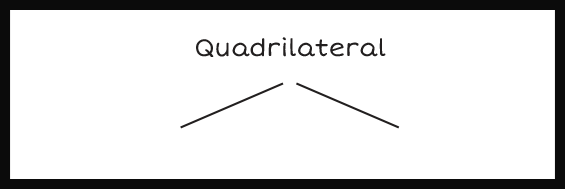
Top of the hierarchy tree: Quadrilateral.

2nd Row

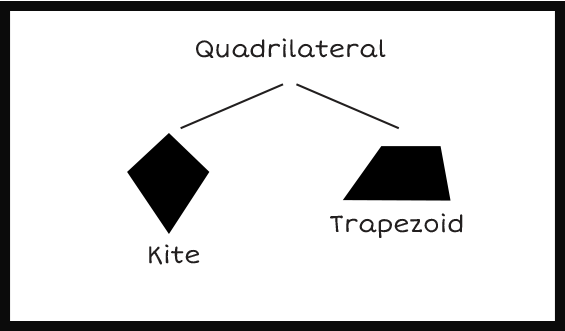
Under the quadrilaterals, we will place the trapezoid and the kite. We know that both are quadrilaterals, so that fits. We know that the kite has no parallel sides, while the trapezoid has one pair of parallel sides. This will be important as we go further down in our hierarchy.

Top of the hierarchy tree: Quadrilateral. Second Row: Kite, Trapezoid.

Keep Going

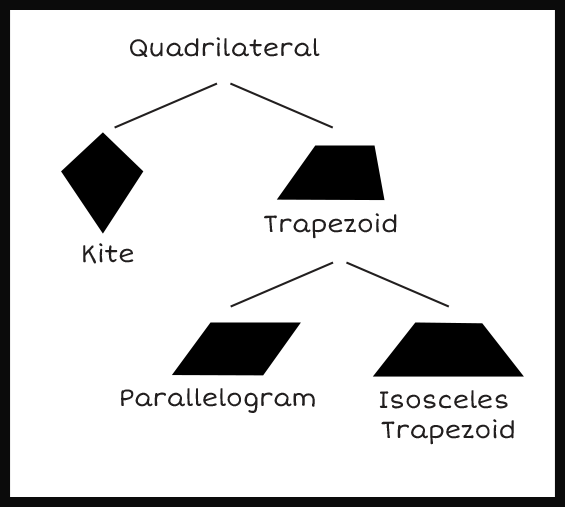
Let's work with the right side and further add shapes under the trapezoid. We know that we can build on the trapezoid to include the isosceles trapezoid. The isosceles trapezoid has all the properties of a regular trapezoid plus a pair of equal sides and angles.

Also, if we build on the idea of a trapezoid having one pair of opposite parallel sides, the next category we can add is the parallelogram, which has two pairs of parallel sides.

Top of the hierarchy tree: Quadrilateral. Second Row: Kite, Trapezoid. Third Row: Parallelogram, Isosceles Trapezoid.

Next Level

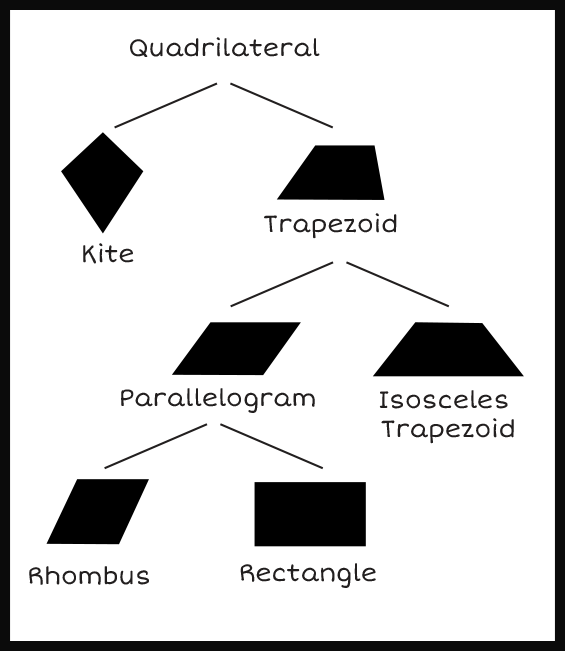
Now, let's look under the parallelogram. We know that a square, a rhombus, and a rectangle are all parallelograms. We know that a rhombus and a rectangle have two sets of opposite sides that are parallel. We can place these two under the parallelogram.

Top of the hierarchy tree: Quadrilateral. Second Row: Kite, Trapezoid. Third Row: Parallelogram, Isosceles Trapezoid. Fourth Row: Rhombus, Rectangle.

Final Level

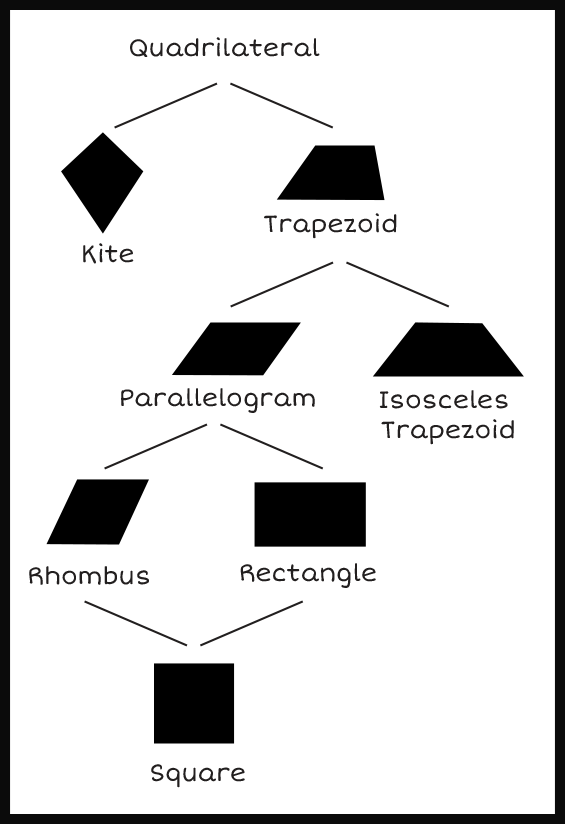
Under both the rhombus and the rectangle, we can place the square. This is because we know that the square shares the property of having two pairs of opposite sides that are parallel. On top of that, the square shares the property of having all four sides equal, which is the same as the rhombus. Also, just like the rectangle, the square shares the property of having all four of its angles equal to 90 degrees.

Top of the hierarchy tree: Quadrilateral. Second Row: Kite, Trapezoid. Third Row: Parallelogram, Isosceles Trapezoid. Fourth Row: Rhombus, Rectangle. Final Row: Square.

This completes our quadrilateral hierarchy!


What attributes did you use to classify the quadrilaterals in this hierarchy?

Your Responses Sample Answers
This hierarchy is based on the angles and the sides of the quadrilaterals.