Newton's First Law explains that an object will keep going what it's doing unless an unbalanced force acts on it. It has a natural tendency to resist a change in its motion. You experience this on a regular basis:
- you turn a corner in your car and your body wants to stay going the direction is was going
- your ketchup won't come out of the bottle unless you move it down quickly and then stop quickly
- you wear a seat belt so that if in an accident you don't fly through the window
The tendency for an object to resist change is called inertia. Some objects have a lot of inertia and some have little, so how can you tell the difference?
Question
Consider two objects that look to be the same size, but one has a lot more mass (and therefore weight) than the other. Which would be most resistant to change it motion?
The more massive object would be harder to get moving, thus the more mass an object has, the more inertia it has. Mass is a measure of inertia.
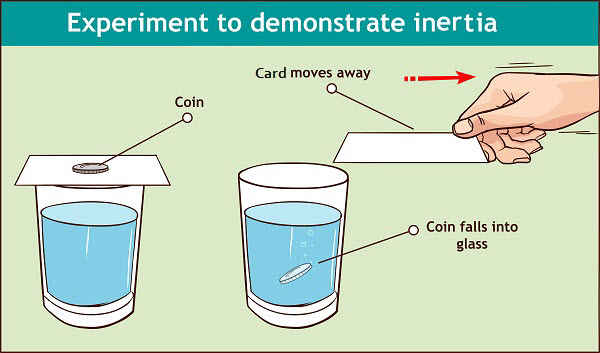
You can do a simple experiment at home to demonstrate the concept of inertia. Fill a small cup with water, place an index card over top. Then, put a coin on top of the cup. If you pull the card quickly, the coin will stay still until gravity acts on it and it falls into the cup. It does not move in the direction you pull the card.
Prior to Isaac Newton, the popular belief was that objects in motion would eventually come to rest without the presence of a force. Of course, now that we know otherwise, we have been able to sustain interplanetary motion without using fuel except when leaving the atmosphere of one planet and descending into the atmosphere of another.
