So far in your physics studies, you have worked through kinematics—the study of motion without taking into consideration its causes. You've also been introduced to the concept of force, which is the cause of that motion. As we transition into the study of dynamics—the study of motion along with its causes—you'll hear a lot about Isaac Newton. In his famous work Principia Mathematica, published in 1687, he described the relationship between a body and the forces acting on it.
Our first focus will be on Newton's First Law, which states that an object at rest will stay at rest and an object in motion will stay in motion (same speed and direction) unless acted upon by an unbalanced force.
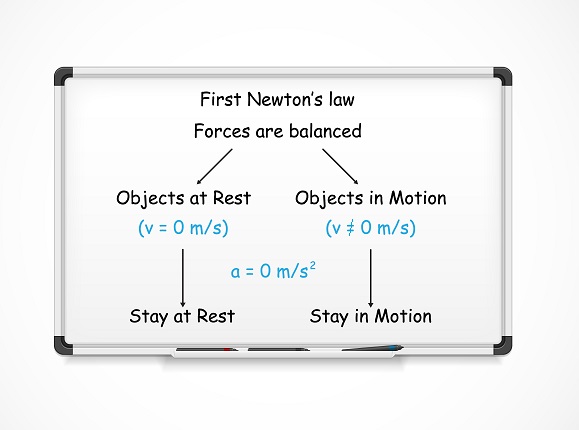
Simply stated, an object will keep doing what it is doing unless an unbalanced force acts on it. It is important to realize that this does not mean that no forces are acting on the object. A force can be present, but if it is balanced by another force, the object's motion will not change. The law also tells you that if an object is at rest or moving with a constant velocity, then the forces must be balanced.
Question
Newton's first law implies that a force is not necessary to keep an object moving at a constant speed. Think for a second, though: if you shove a book across the table, as soon as your hand leaves the book, it usually slides to a stop. Why does this happen?
This is not a matter of a force being absent after it leaves your hand, it is a matter that there is a force present after it leaves your hand to slow it down. If there was no force (friction), then the book would keep going forever.
