Fundamentals of Art - Shape and Form
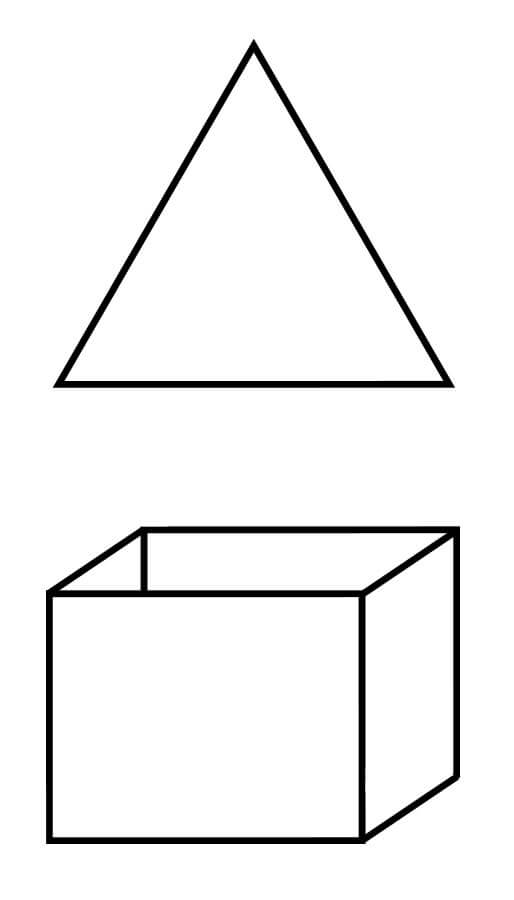
Fig 1.3. Shape and Form.
Image courtesy Daniel B.Chapman.
Lines can be used to create shapes, which are another element of art. Shapes are two-dimensional and have clear borders or outlines. Since they are two-dimensional, shapes do not have depth; they only have height and width. A shape can be geometric, like a square or circle, or it can be organic, like a two-dimensional representation of an animal. Three-dimensional representations of objects are called forms, and are another element of art. A drawing of a cube that demonstrates depth through shading, contour lines, or highlights, is an example of a form. Although drawings are always two-dimensional, because the object appears three-dimensional it is called a form, rather than a shape.
Figure 1.3 demonstrates the difference between shape and form. Each composition is created by lines; the triangle is an example of a shape and the cube is an example of form. Shapes lack the three-dimensional aspect whereas forms appear three-dimensional.
Lines, shapes, and forms are three of the formal elements of art. The next module will discuss the remaining elements of art: space, color, and texture.
Reflection Question

In the painting below, where do you see shapes (2-dimensional)? Where do you see forms (3-dimensional)?
