Ocean Features Slideshow
Read through the slides to learn about the physical features of the ocean.
Goal:
Goal:
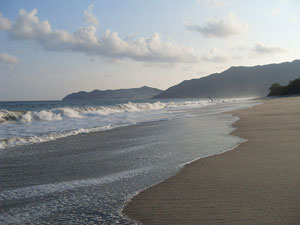

At the coastline, the land meets the sea. Here the land continues under the water into a broad, shallow plain called the continental shelf. The continental shelf is about 75 kilometers (km) wide and barely slopes at all. Its depth is about 200 meters (m).
About 100 km from the shore a steep drop called the continental slope begins. The continental slope really marks the edge of the continent.
Many continental slopes end in a gently sloping, smooth-surfaced feature called a continental rise. Continental rises have been found to consist of thick deposits of sediment, probably deposited as a result of currents carrying sediment off the shelf and slope.
At a depth of about 2,500 m the continental slope begins to lessen, and gently continues down to a depth of about 5,200 m, to what is called the ocean floor.
At various places on the ocean floor, there are long chains of underwater mountain ranges called mid-ocean ridges. These extend for hundreds or thousands of kilometers along the ocean floor, in the same way that mountain ranges extend on the land above.
The ocean floor lies deeper below sea level than land rises above sea level! The average depth of Earth's oceans is 3.8 km. The deepest places on the ocean floor are more than 11 km below sea level. Mount Everest, the highest mountain on Earth, is only 8.8 km above sea level, by comparison.
At the deepest ocean depths, there is no light and there is intense pressure from the force of all of the water above. Still, life exists at these depths like nothing seen anywhere else.
Ocean water varies in temperature. The surface temperature of the ocean is just above the freezing point around the poles and as high as 30 degrees Celsius near the equator. The ocean also varies in pressure. The highest pressure can be found at the deepest place on Earth, the Mariana Trench.
