California Architecture
What famous architectural designs can be found in California?
Goal:
Goal:
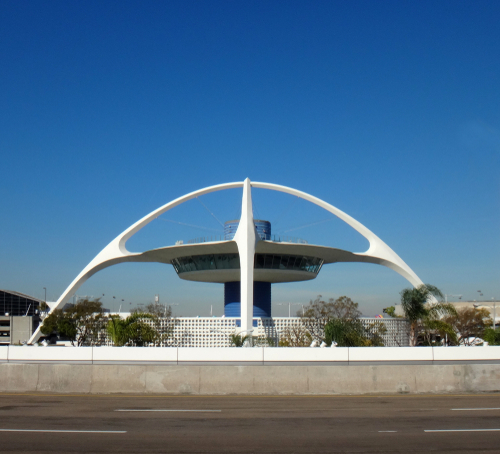
California has lots of unique architecture. For example, just look at the airport design in Los Angeles.
Let's explore more of California's architecture. You know that the Spanish created missions in California. But did you know that in addition to influencing culture and religion, the Spanish missions also influenced architecture? Watch this video to learn about mission architecture.
 When you drive through your hometown or visit other areas of California, you may notice that many buildings have a similar design. Stuccoed or plastered white walls, tiled roofs, arched doors or windows, and courtyards are a few features that might catch your eye. This architectural style is called Mission, and it's been an important part of California's history and culture for over 200 years. Architecture is the art and science of designing buildings and structures. The design of a building can say a lot about the history and culture of the people who built it.
In California, some of the first architects were Spanish priests who arrived in 1769 when the territory was a colony of Spain.
They established mission churches to convert local Indians to Christianity. Permanent settlements, called pueblos, grew around these churches. By 1823, 21 missions stood along the California coast. Some became major cities, such as San Diego and San Francisco. These early mission settlements were the foundation for California's rich history and cultural diversity.
Franciscan missionary Junipero Serra led the first expedition of Spanish soldiers and priests up the California coast in 1769. These men weren't trained carpenters or builders, so they tried to copy structural designs that were common back in their homeland. As a result, California missions featured different Spanish architectural styles. The two major influences were Roman and Moorish design elements. Built in 1786, Mission Santa Barbara had an arch-and-dome construction similar to structures seen in Spain or other parts of Europe.
About 2,000 years ago, the Roman Empire controlled much of Europe, including Spain. One of their lasting legacies was architecture. The Romans used half-round arches in most of their public buildings, like the Colosseum, and it was a design element seen throughout Europe. Other Roman elements in mission design included belfries, or bell towers, and stone facades.
A facade is the front of a building. And at Mission Santa Barbara, the facade was patterned after an ancient temple in Rome. The original vaulted roof of Mission San Gabriel Archangel near Los Angeles was modeled after a cathedral in C?rdoba, Spain.
Here Moorish design elements and patterns were used, including horseshoe-shaped arches and detailed carvings in the stonework. The Moors were a Muslim people from northern Africa who ruled Spain until 1492. They left a lasting influence on Spanish culture, art, and architecture. In fact, the cathedral in Cardoba, Spain, that Serra used as a model for Mission San Gabriel Archangel was originally a Moorish mosque. Carmel Mission, in Northern California, also shows a Moorish influence. While some missions showed Roman design elements and others Moorish patterns, most all of them had fountains in their courtyard, beautiful gardens, and large, open spaces where people could gather or hold religious celebrations.
When you think of New York City, you think of skyscrapers. Georgia and other Southern states remind you of plantation homes.
New England states like Massachusetts bring to mind colonial buildings. Now when you think of California, you'll recognize that Spanish Mission is the state's signature architectural style.
 |

Take out your activity page and decide what symbol you want to use for a place of architectural interest. Add your symbol to your map key and write "architectural interest" next to it. 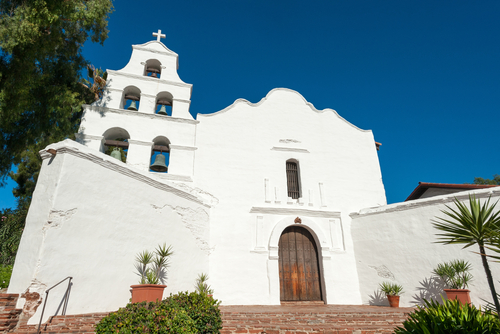
First, look at some mission architecture. There are missions all over California to visit. Here is a picture of the mission in San Diego. See if you can recognize the various mission features you just learned about in the video. 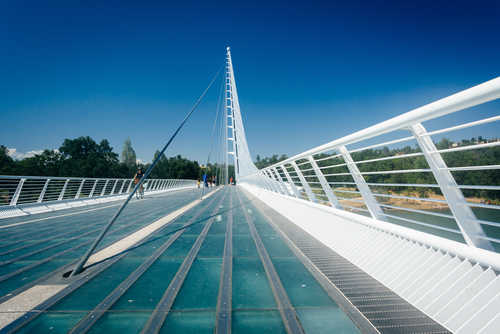
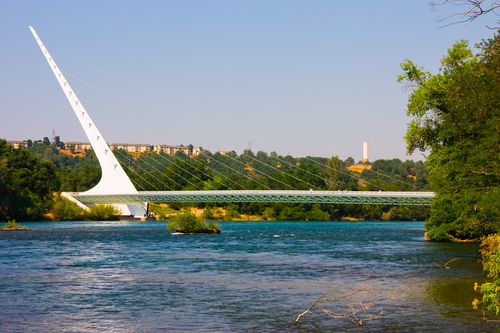
Next, look at this bridge, called Sundial Bridge, in Redding, California. It is a 700 foot art piece that you can walk on. The glass block walkway is over the Sacramento River. This style of architecture is futuristic. 
Another famous California bridge is the Golden Gate Bridge in San Francisco. Its color is a defining attribute in its design. How did the color come to be? When the steel was installed, it was covered with red primer. Primer is a paint base that you use before painting the final color. An engineer liked how the primer looked and wanted the final color to remain red. 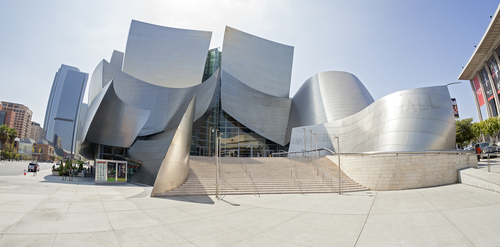
Next, take a look at the Walt Disney Concert Hall in Los Angeles. Stainless steel panels were used to create this amazing architecture. The project was completed in 2003 and cost approximately $274 million dollars. 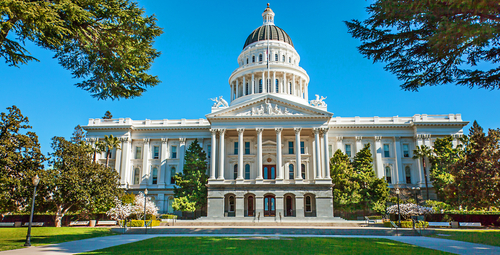
The building where California laws are passed has great architecture, too. California's State Capitol Building in Sacramento is a similar design to the White House with its white columns and cupola. 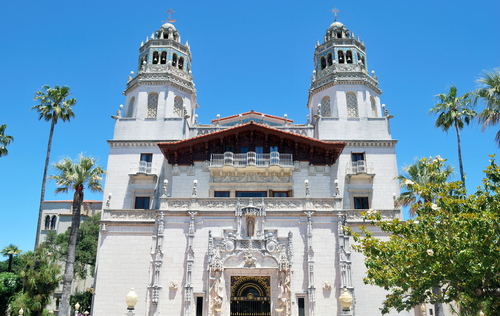
Lastly, look at Hearst Castle in San Simeon. California's first female architect, Julia Morgan, designed it for a wealthy Californian. This castle has 165 rooms and is situated on 127 acres that includes fountains, gardens, and pools. 
There is so much amazing architecture to see in California. Choose your favorites and mark three to five of them on your California map. |
 |