Rivers
How do rivers form, and how do they affect land?
Goal:
Goal:

Rivers usually flow into the ocean. Most areas of the United States have at least one river. Some of these rivers are short, and some, such as the Mississippi River, are very long. The Mississippi River is the longest river in the United States; it is nearly 3,800 km long.
Some rivers begin as tiny trickles of water flowing out of a lake. Other rivers begin as water that bubbles up from under the ground. But most rivers begin when rain and snow fall on mountains and hills--as the snow melts, it trickles down the mountainside to form tiny streams. Then, many tiny streams join together to make bigger streams. Eventually, these streams form a river.
As a fast-flowing river pushes hard against the soil on both sides of its banks, it loosens the sand, stones, and plants, and they are swept into the moving water. This wearing away of the ground is called erosion.
When the water in a river moves very slowly, it does not carry bits of rock, sand, and plants with it. Instead, these become sediment on the bottom of the river. When a lot of sediment falls to the bottom, it eventually builds up to form a new piece of land, which is called an island.
The land that is flooded when the river water spills over its banks is called a flood plain. Rivers often flood during heavy rains, which cause the water to go over the river's banks. A flood plain contains very good soil for growing crops.
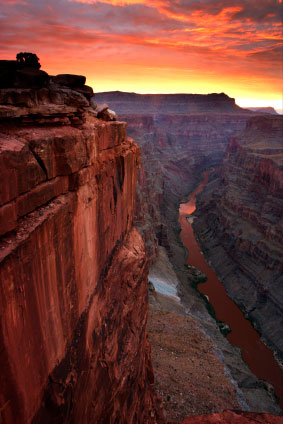 An example of a river's power can be seen at the Grand Canyon. A canyon forms when a river erodes--or wears away--dry, rocky land over time. The water slowly cuts a path that gets deeper and deeper over millions of years. Click the picture to the right to see a larger image of the Grand Canyon.
