During the first half of the 19th century, when Romanticism emerged as a literary movement, the United States of America was still a very young country. It was no longer a small country, though, in land or in population. The Louisiana Purchase had doubled the geographic size of the United States, and immigrants continued to pour in from all over Europe, not just England.
The literature of the period reflected the tensions created by such rapid growth. Most Americans wanted desperately to "feel like Americans," but what did that mean for so young a country—especially a country consisting of people born and raised in many other countries (or in various different Native tribes)? Each immigrant brought his or her own culture and identity, which needed to be merged with that of other immigrants to arrive at any kind of national identity.
By the mid-1800s, some aspects of experience had become central to life in America, and writers of the time included these themes and ideas in their works—sometimes celebrating them and sometimes reacting against them. Use the tabs below to explore the most central ideas found in the texts written during this time.
Manifest Destiny
Industrialization
Nationalism
Westward Ho!
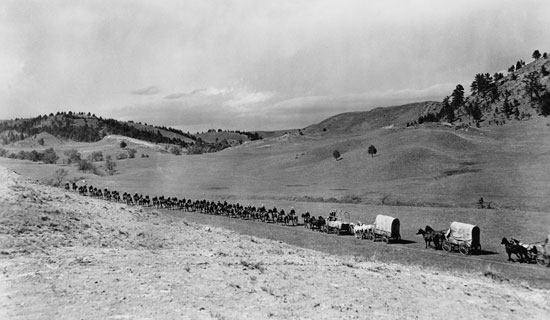
Just as the first European settlers felt they had a right to claim land in America and use it for their own purposes, citizens of the United States believed they were justified in expanding their new civilization as far west as they could go. Americans called this right their "manifest destiny," and it eventually became an actual government policy. Americans were encouraged to lay claim to tracts of land still occupied by Native Americans, whose societies had lived there for centuries. The government's army made sure that any retribution from displaced Native peoples was contained and controlled. Many Romantic writers found the pioneer's desire for adventure admirable, but they weren't so sure about the ways in which more "primitive," and thus more pure, Indigenous peoples were treated in the process.

Made in America
America became industrialized in the 1800s, following England's example. Once the Revolutionary War had severed the former colonies from their Motherland, Americans had little choice. In order to trade with other countries and sustain their own economy, they needed factories to produce the goods that had been made in England before the war. Factories were built mostly in the Northern states at first, where agriculture was less of a viable economic system. Raw materials grown and harvested in the South, such as cotton, wool, lumber, corn, and sugar, were shipped to northern cities, where they were processed or used to make textiles and other manufactured goods. American writers witnessed firsthand the factory conditions for which many Americans left farming and rural life.


How united are we?
Although the colonies were now states united by a constitution, a national identity was still very much in the works. There were challenges to the new government's efforts to get everyone on the same page. The Northern and Southern regions of the country were very different economically and socially. The impulse of nationalism (a feeling of pride in the country as a unified whole) competed with tendencies toward sectionalism, a sense of identity with a smaller group consisting of people living in your same state or region. Writers expressed these feelings and the tension between them in literary works of various forms.
Question
What geographic and social division echoed the Romantics' tendency to elevate rural characters and settings?
