The first human civilizations emerged out of the world of hunter-gatherers about 10,000 years ago. This was a time before writing existed and records were kept. Historians and scientists refer to the time before written records as prehistory.
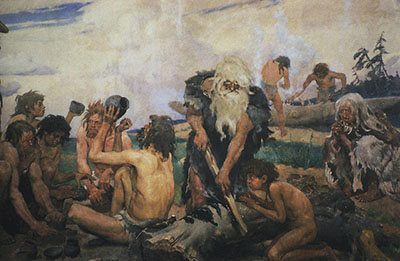
Following the end of the last Ice Age,around 11,500 years ago, people spent their days hunting game and gathering plants. Because the hunter-gatherer bands had no permanent dwellings, and no writing, they left very little evidence for us to use to understand their experience. What remains are mostly artifacts, such as tools, and sometimes animal remains. Archeologists use this scarce evidence to help us imagine the lives of prehistoric peoples.
Use this slideshow to learn what archeologists believe to be true about hunter-gatherer societies.
|
|
Hunters and gatherers in the late Stone Age
Following the wild game, these small groups of people moved with food, mostly seasonally, but sometimes more often, depending on how far they had to migrate. They were nomadic in this way, without permanent settlements.
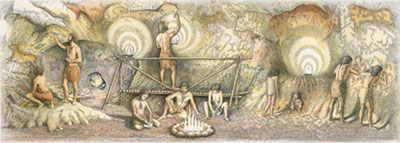
Hunters and gatherers sometimes lived in caves, or they set up seasonal campsites.
In the years before the rise of agriculture, the tool and weapon development of hunters and gatherers was also evolving. The hunter-gatherers of this period used stone, wood, and bone to craft their tools and weapons. Tool and weapon collections that were once made up of only blunt arrowheads and spears now included axes, hoes, adzes (an ax-like tool with a curved blade, used for shaping wood), bows and arrows, hammer stones, and pottery. The tools and weapons were also more intricately made and might have engravings and carvings.
This period also saw advances in art through cave paintings and statuette sculptures. Cave paintings illustrated everything from hunting to nature scenes, while statues depicted various human forms, especially that of Venus, which reverently depicted the female figure.
|

|






Question
How did people survive 13,000 years ago?
Question
Why do scientists and historians believe that hunter-gatherer groups had only small numbers of people?
