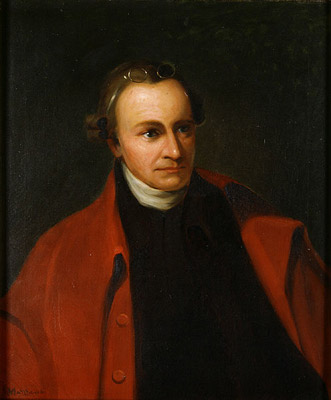
Like Thomas Paine, Patrick Henry had several failures and false starts in life before he found his vocation. He wasn't much of a farmer or a merchant, but he eventually discovered that he was a natural at crafting and delivering speeches. Henry's talent first found expression in the practice of law. Soon, however, he branched into politics.
In 1765, at the age of 29, Henry was chosen as a political representative in the Virginia House of Burgesses. There, he delivered the two most famous speeches of the American Revolutionary era. The first was an impassioned speech in support of his resolutions against the Stamp Act, a much-hated act of the British Parliament that created a new tax on all American newspapers and public documents. Patrick Henry seemed especially keen to have his own contributions to the colonies' rejection of the Stamp Act remembered. On the back of his copy of the Stamp Act Resolutions, Henry wrote this note:
 The within resolutions passed the House of Burgesses in May, 1765. They formed the first opposition to the Stamp Act and the scheme of taxing America by the British Parliament. All the colonies, either through fear, or want of opportunity to form an opposition, or from influence of some kind or other, had remained silent. I had been for the first time elected a Burgess a few days before, was young, inexperienced, unacquainted with the forms of the House, and the members that composed it. Finding the men of weight averse to opposition, and the commencement of the tax at hand, and that no person was likely to step forth, I determined to venture, and alone, unadvised, and unassisted, on a blank leaf of an old law-book, wrote the within. Upon offering them to the House violent debates ensued. Many threats were uttered, and much abuse cast on me by the party for submission. After a long and warm contest the resolutions passed by a very small majority, perhaps of one or two only. The alarm spread throughout America with astonishing quickness, and the Ministerial party were overwhelmed. The great point of resistance to British taxation was universally established in the colonies. This brought on the war which finally separated the two countries and gave independence to ours. Whether this will prove a blessing or a curse, will depend upon the use our people make of the blessings which a gracious God hath bestowed on us. If they are wise, they will be great and happy. If they are of a contrary character, they will be miserable. Righteousness alone can exalt them as a nation. Reader! whoever thou art, remember this; and in thy sphere practise virtue thyself, and encourage it in others.
Though he claimed to be more proud of his speeches and writing in opposition to the Stamp Act, Patrick Henry is more widely known for his "Speech to the Virginia Convention," the speech you're about to read. Delivered in 1775, it had its intended effect: Though initially divided, the Virginia legislators voted to arm their people against the British. Less than a month later, the Battle of Lexington in Massachusetts led to all-out war.
Question
Consider how Patrick Henry described his role in opposing the Stamp Act. What does this story tell you about Henry's character?
