 |
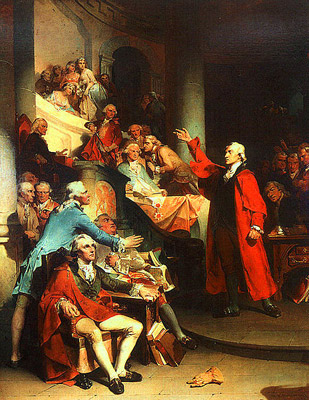
| If this be treason, make the most of it. |
In a dramatic speech before the House of Burgesses, Henry urged his fellow legislators to pass his five resolutions against the Stamp Act. The first four resolutions established that the Virginia colony had a right to vote on the taxes imposed on its people. The fifth and most extreme resolution flatly rejected British authority to tax the colonists without their consent. After Henry spoke, another politician stood and shouted, "Treason, treason!" Yet despite the outcry of some conservative legislators, Henry's first four resolutions passed.
Now, flash forward to 1775: Henry again took the floor to call for resistance to the British. By then, tensions had escalated dangerously, and the British military presence in the colonies had become an undeniable threat. To add insult to injury, the British Crown was demanding that the colonists pay more taxes to fund the British troops. In response to the British lack of compromise, Henry gave his second famous speech. Read the first paragraph of the speech below. As you read, think about Henry's implicit, or indirect, message to those who would accuse him of treason.
MR. PRESIDENT: No man thinks more highly than I do of the patriotism, as well as abilities, of the very worthy gentlemen who have just addressed the House. But different men often see the same subject in different lights; and, therefore, I hope it will not be thought disrespectful to those gentlemen if, entertaining as I do, opinions of a character very opposite to theirs, I shall speak forth my sentiments freely, and without reserve. This is no time for ceremony. The question before the House is one of awful moment to this country. For my own part, I consider it as nothing less than a question of freedom or slavery; and in proportion to the magnitude of the subject ought to be the freedom of the debate. It is only in this way that we can hope to arrive at truth, and fulfill the great responsibility which we hold to God and our country. Should I keep back my opinions at such a time, through fear of giving offense, I should consider myself as guilty of treason towards my country, and of an act of disloyalty toward the majesty of heaven, which I revere above all earthly kings.
Question
Henry knows that he may be accused of treason against the British because of what he is about to say. What argument does he give to justify his speech?
