When we try to express what something is like, we use figurative language - painting a picture with words might help you to understand this better. Let's look at the following passage from Water Babies to illustrate what we mean:
from Water Babies
Tom was so astonished that he never said a word but he stared with all his eyes. And he went up to the top of the water too, and peeped out to see what would happen.
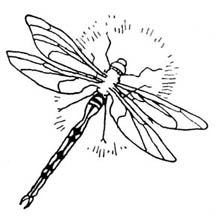
And as the creature sat in the warm bright sun, a wonderful change came over it. It grew strong and firm; the most lovely colors began to show on its body, blue and yellow and black, spots and bars and rings; out of its back rose four great wings of bright brown gauze; and its eyes grew so large that they filled all its head, and shone like ten thousand diamonds.
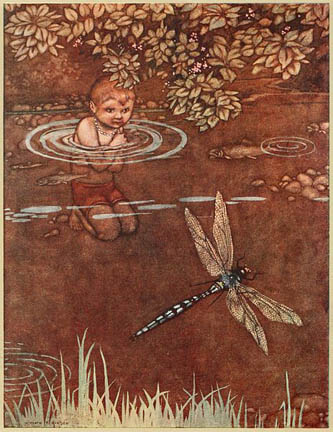 "Oh, you beautiful creature!" said Tom; and he put out his hand to catch it.
But the thing whirred up into the air, and hung poised on its wings a moment, and then settled down again by Tom quite fearless.
"No!" it said, "you cannot catch me. I am a dragonfly now, the king of all the flies; and I shall dance in the sunshine, and hawk over the river, and catch gnats, and have a beautiful wife like myself. I know what I shall do. Hurrah!" And he flew away into the air, and began catching gnats.
"Oh! come back, come back," cried Tom, "you beautiful creature. I have no one to play with, and I am so lonely here. If you will but come back I will never try to catch you."
"I don't care whether you do or not," said the dragonfly; "for you can't. But when I have had my dinner, and looked a little about this pretty place, I will come back, and have a little chat about all I have seen in my travels. Why, what a huge tree this is! and what huge leaves on it!"
It was only a big dock: but you know the dragonfly had never seen any but little water-trees; starwort, and milfoil, and water-crowfoot, and suchlike; so it did look very big to him. Besides, he was very short-sighted, as all dragonflies are; and never could see a yard before his nose; any more than a great many other folks, who are not half as handsome as he.
 Take a few minutes to think about the passage. We might notice a certain mood, that is, some kind of emotion that we feel after reading. In the first paragraph, we sense some of the amazement that Tom might feel when we read that "he stared with all his eyes." Every piece of attention was directed at what he was seeing. And what he was seeing (the dragonfly) seemed quite big despite the fact that it was small (as things sometimes do look when a person feels small or alone). The description therefore sets a mood.
Mood is perhaps the most fundamental form of figurative language, because it transports us beyond the mere words by giving us a taste of the experience beyond the words. Mood can be conveyed through any of the senses, but we will most often see it portrayed with images.
