In the beginning of this lesson, you learned that a brush can make lines. It is a versatile tool and can do other things: When an artist uses a brush to make drawings the artist has a softer, broader tool than the sharp, hard pencil or pen. With the softness of the brush and the fluid quality of the ink, the artist can make broader areas of dark tones—not just thin lines. Since the ink is transparent and fluid, like watercolor paint, the dark tones may flow from dark into light with looser and more gradual blending. The dark tones made with brush and ink will not have the sharp-edged, flat shapes of cut paper; and when the ink is mixed with water it creates even more of a loosely structured drawing
Compare the use of light to dark wash to create value on the drawing below with the clearly defined edges of the cut paper landscapes illustrated previously. Answer the following questions on your lesson worksheet or on a separate piece of paper.
- Which areas on the building have the darkest tones?
- Which areas have the lightest tones?
- Which areas have a middle tone?
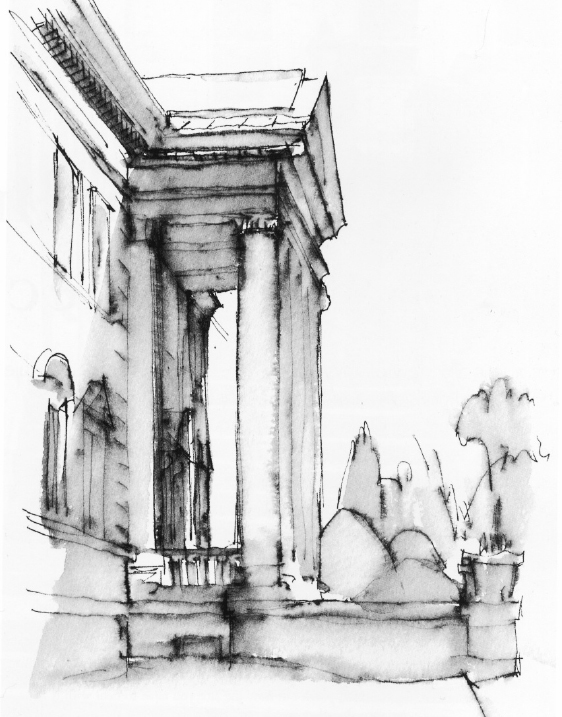
The portico at Broadlands, Hampshire.
