A character is a person, animal, or entity that a story is about. Characters, of course, have an important impact on a story’s plot--the series of events in a story.
Characterization is the process by which an author communicates information about a character. Characterization tells a reader what a character looks like but also how a character thinks and feels and interacts with others.
Besides revealing characters' personality traits, characterization may provide clues about what will happen in the story. As an example, let's look at the very short classic fable "The Tortoise and the Hare."
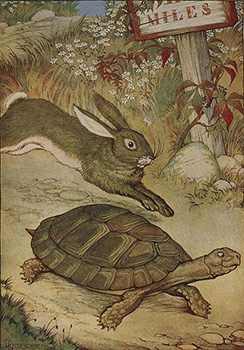 A Hare was one day making fun of a Tortoise for being so slow upon his feet. "Wait a bit," said the Tortoise. "I'll run a race with you, and I'll wager that I win."
"Oh, well," replied the Hare, who was much amused at the idea, "let's try and see."
It was soon agreed that the fox should set a course for them, and be the judge. When the time came to start their race, both started off together, but the Hare was soon so far ahead that he thought he might as well have a rest. So down he lay and fell fast asleep.
Meanwhile the Tortoise kept plodding on, and in time reached the finish line. At last the Hare woke up with a start, and dashed on at his fastest, only to find that the Tortoise had already won the race.
In this story, the Hare is characterized as quick but conceited. The Tortoise is characterized as slow but determined. Before you reach the end of the story, you can probably guess that the Tortoise will win the race, because the story already suggests that being determined and working hard is more admirable than pride and carelessness. Readers would not expect the Tortoise to win if he were slow and lazy. Nor would they expect the Hare to lose if he were fast and humble.
Question
In a fable starring a lazy lion, a reliable dog, and menacing rat, which character would you expect to be the hero?
