As you've learned, explicit details are precise and direct. They're also easy to see and understand. Implicit details are different. Readers understand implicit parts of the story by interpreting clues in the text. This may sound more complicated to you than it actually is. When listening to stories, you interpret details without even realizing it.
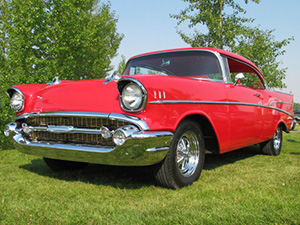 For example, when describing this car, you might say, “It is red.”
This detail is explicit because it is a simple fact about the car--the car is red and cannot be any other color.
However, if you were to say, “The car is the color of an apple,” the detail would be implicit because it requires interpretation. Most people will interpret this detail to mean that the car is red. A reader or listener is very likely to picture a red car even though the color was never explicitly stated. (That's only true, of course, for people who have seen an apple.)
With implicit details, there is interpretation involved, so there is also room for misunderstanding. For example, it is possible that readers might interpret the car to be light green because there are green apples.
Click through this slideshow to learn more about the difference between explicit and implicit details.
|
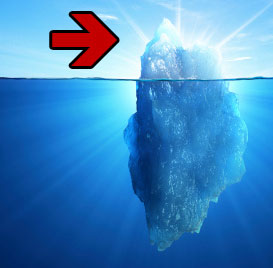
An easy way to remember the difference between explicit and implicit details is to picture an iceberg. As you may know, only a portion of an iceberg is visible above water. The rest of the iceberg, sometimes up to 90 percent of it, is hidden beneath the water. From the surface, you can only guess, or infer (use what you can see to make an educated guess about) what the iceberg looks like beneath the water.
In this way, the iceberg visible above the water is like explicit detail. You can gather a lot of information about the iceberg by what is visible above the water. You can see its color and shape. You can measure it from side to side, mark its jagged edges, and read the temperature of its frozen ice. All the details are at your fingertips and need little interpretation to be understood.
The iceberg underneath the water, on the other hand, is like implicit detail. To understand its color, shape, size, and temperature, you must interpret what is seen above the water. Scientists, of course, use complicated machinery, research, and mathematical equations to find these details. The casual observer, though, must interpret the visible details and then make an educated guess about what is below the surface. |
 |



Look closely at this photograph of a woman standing on a yacht. Some information in the photograph is immediately clear to viewers--those are explicit details. Some information will have to be inferred by viewers, though--those are implicit details.

|
explicit
|
The woman is wearing expensive shorts.
The woman is wearing white shorts.
|
|
implicit
|
The woman is waving.
The woman has her hand raised.
|
|
explicit
|
There is a city skyline in the background.
The photo is taken off the Miami coast.
|
|
implicit
|
It is a sunny day.
It is a hot day.
|
Complete
Question
What is the difference between explicit and implicit details?
