The easiest way to help another person understand what you saw during an event or experience is to describe it in a very explicit, or direct, way. Explicit details are precise nouns, verbs, or adjectives used to show exactly how something looks, sounds, smells, or feels—or, in some cases, exactly what happened. Explicit details are much less likely to be misunderstood by readers because they don’t require readers to guess at their meaning. The meaning is obvious.
For example, at the doctor's office, you may be given a questionnaire that asks you for a description of yourself: your gender, age, height, weight, exercise regimen, and diet. All of these details create an explicit description of who you are. Each question has only one answer, one that can be measured and verified. There is no room for interpretation: You are either 5 feet tall or 6 feet tall.
In this illustration, there are many explicit details we can list:
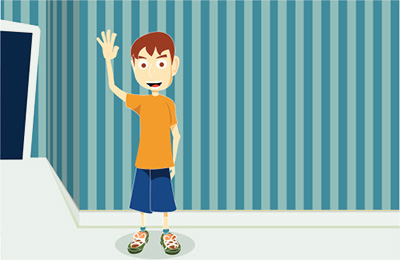
- This is an illustration of a boy standing in a room.
- The walls of the room are striped blue and light blue.
- The boy wears blue shorts, an orange, short-sleeve t-shirt, blue socks, and brown sneakers.
- The boy’s mouth is open, revealing white teeth and a red tongue.
- The boy’s hand is raised.
All of these details are explicit because they provide a simple description rather than a writer's interpretation of the illustration--his or her guesses about what is happening in the picture or what the picture means.
Question
Why isn’t the fact that the boy is waving an explicit detail?
