Perspective
One of the most effective ways that artists create space in two-dimensional art is through the use of perspective. Perspective is a way that artists can make an object appear three-dimensional, even on a flat, or two-dimensional, surface. Perspective relies on three principles. First, the horizon (where sky and earth meet) is at eye-level; second, all lines parallel to the viewer recede to the vanishing point; and third, all diagonal lines meet at the vanishing point.
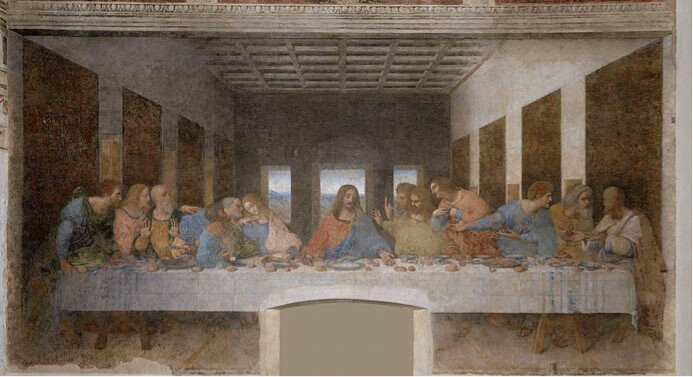
Fig 3.5. Leonardo da Vinci, The Last Supper (c. 1495-1498).
Image courtesy of Wikimedia Commons.
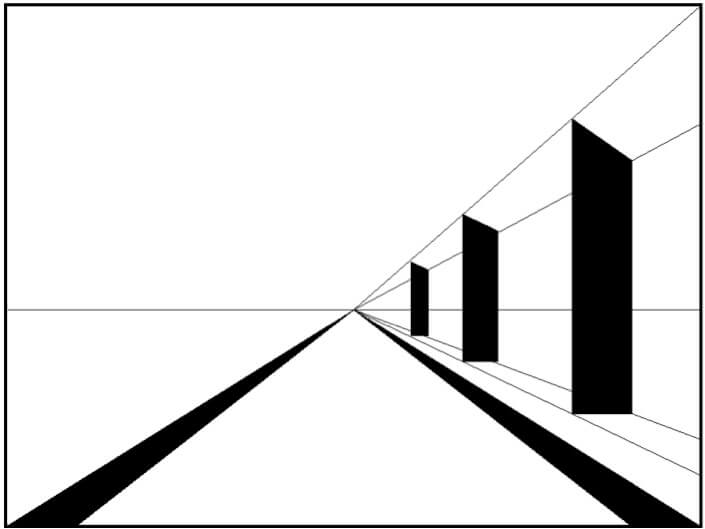
Fig 3.4. Perspective.
Image Courtesy of Daniel B. Chapman.
Figure 3.4 is a simple example of a single vanishing point. Objects in the near plane appear closer than objects near the horizon. All elements scale proportionally to their distance from the vanishing point. The shape on the far right appears closest because of its size. Leonardo da Vinci's famous painting The Last Supper uses this same principle. The lines on the ceiling, walls, and even those created by the edges of the table all lead towards a single vanishing point in the center of the painting, approximately at Christ's head. Notice that the horizon, visible through the rear doorway, is also at this level.
Header Art Image Courtesy of Wikimedia Commons.
