You've learned that editorial writing is all about opinions: instead of focusing on facts, an editorial focuses on expressing a point of view or perspective. Editorial cartoons are a special form of editorial that combines words with cartoon-style images.
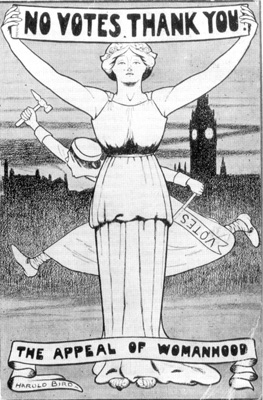
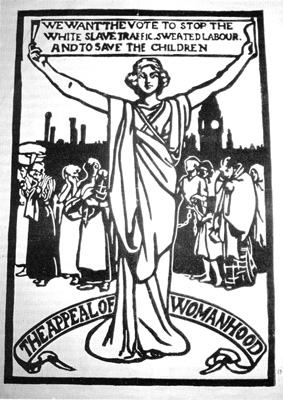
In 1912, suffrage, or voting rights, for women was a fiercely controversial issue in Great Britain as well as in the United States. The first editorial cartoon below was published by the National League for Opposition to Women's Suffrage. The second editorial cartoon was created by Louise Jacobs as a response to the NLOWS cartoon.
Question
What is the opinion expressed by the NLOWS' cartoon? What is the message of the second cartoon?
The NLOWS cartoon expresses the opinion that voting is unwomanly. Jacobs' counter-message is that women want the vote to accomplish goals that are important and meaningful to women.
Question
How does the second cartoon use a visual reference to the first cartoon to make its point?
The first editorial cartoon uses an image of a Greek goddess to represent the height of womanliness. Jacobs' cartoon also uses an image of a Greek goddess to drive home its retort: the height of "womanhood" is moral improvement of the world.
