Think of your own body. You are made up of water, bone, skin, and tissue. You are not made of one substance, you are not a smooth surface, and you are not evenly shaped.
Gravity pulls downward on every particle in every object with a force that is directly linked to the particle's mass. This means that each particle of your body is pulled a little differently by Earth’s gravity. (Now imagine trying to draw individual vectors to represent the gravitational force on each particle in your body. It would be impossible.)
Recall that the direction of the arrow on a vector represents the direction of the force. The length of the vector represents the amount of force acting on the object. All of the forces acting on an object can be combined into a single vector. In the case of gravitational force, the resultant vector has both a length and direction which represents the magnitude and direction of the gravitational force acting on the object.
The point on the object that is on the tail of that vector is called the center of gravity. The center of gravity is a point on an object where the force of gravity can be considered to act. The center of mass of an object is a point on the object such that if a uniform force is acting on the object, the point moves in the same path that a single particle would move if the force was exerted only on the single particle. If the force due to gravity is uniform, the center of mass is the same as the center of gravity.
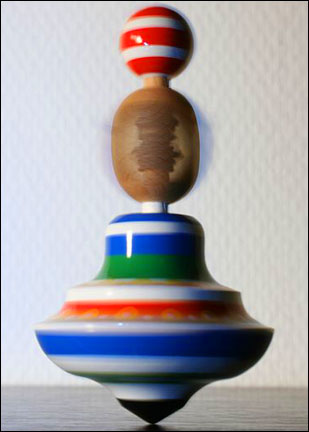
The spinning top shown in the photo spins around its center of gravity.
Center of Mass
What must be true before the center of mass is in the same location as the center of gravity for an object?
