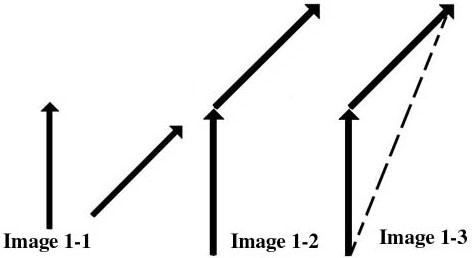
 Now let's add the force vectors to find the resultant. First draw force vectors for each of the forces, using the direction of the arrow to represent the direction of the force and the length of the arrow to represent the amount of force as shown in Image 1-1.
 Next you redraw the force vectors head-to-tail, in any order. You must redraw each of the vectors with exactly the same length and going the same direction as the original drawing, as shown in Image 1-2. To find the magnitude and direction of the resultant force, draw a single resultant vector from your starting point (the beginning of the first vector) to the end of the last force (the tip of the second vector). This is the resultant force vector shown in Image 1-3.
You measure the resultant vector's length to determine the magnitude of the force, and you measure the angle of the resultant vector to determine the direction of the force. The direction and magnitude of this resultant vector is the net force acting on the object. If these two forces are acting on an object, the object would shift in the direction with the magnitude of the resultant force.
Adding Force Vectors
What two factors must you duplicate when you are redrawing vectors to find the resultant vector?
You must duplicate the magnitude and direction of EACH force vector that is applied to an object.
