When we are looking at forces that act two dimensionally we will make accurate to scale drawings using a ruler and protractor. We will be determining the net fore that is acting on the object.
If we have a pack of three dogs that are each pulling on leashes in different directions. The table below shows how the three dogs are pulling. The diagram show you visually from a top view how they are pulling.
| Angle (in degrees) | Force (in Newtons) | |
| Dog 1 | 225° | 20 N |
| Dog 2 | 270° | 50 N |
| Dog 3 | 45° | 30 N |
To be consistent with the designation of direction, imagine a map oriented the usual way with east to the right and north pointing up. If you were to measure the angle with a protractor, east would be at 0°, north would be 90°, west would be 180°, and south would be 270°. If your line pointed directly northeast, it would be at 45°. Let’s use this standard in all our measurements of force vector direction. In other words, we are measuring counter-clockwise from east. The length of the line you use depends on the scale you choose. For example, our scale will be 1 cm will equal 5 newtons.
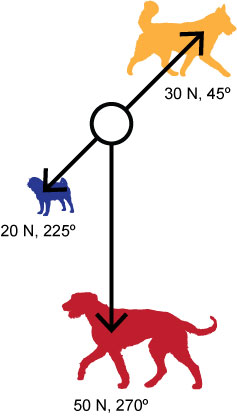
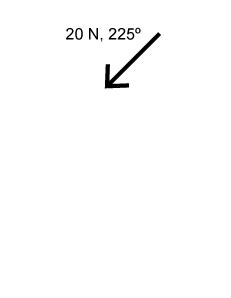
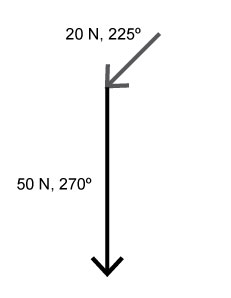
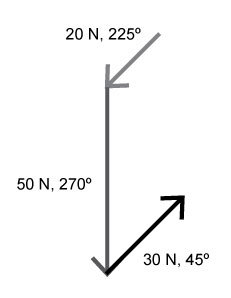
Click through the slideshow to see the solution. The forces must be placed head to tail like the diagram below. The resulting force is the force represented by the dashed arrow. Try and diagram this on your paper and see if you get the same answer.
|
|
 |

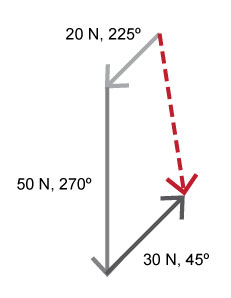
Force
What is the resulting force?
