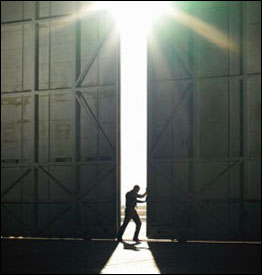
What if you push on a wall or a heavy door and it moves? This is an example of unbalanced forces. If either the magnitude of the forces or direction of forces are not exactly opposite, then the forces are unbalanced forces. Unbalanced forces change the motion of the object acted upon. An unbalanced force can make a stationary object move. It can change the speed of a moving object by causing it to speed up, slow down, or change direction. The same unbalanced force will move an object with more mass more slowly than an object with less mass.
For example, if you kick a ball, you are providing an unbalanced force on the ball. The unbalanced force acts on the ball and makes it move.
If the ball is so heavy that your kick could not move it, then the ball would be exerting an equal and opposite force on your foot. The ball would remain in place because the forces are in equilibrium. In other words, the forces are balanced forces.
Unbalanced forces
What is the definition of an unbalanced force?
