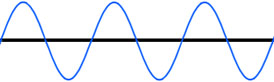
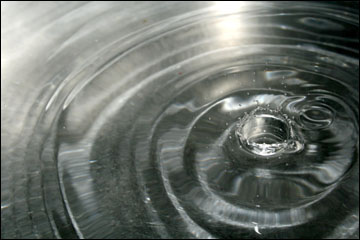
 There are two types of waves, transverse and longitudinal. Transverse waves move in a direction perpendicular to the force that creates them. For example, if you drop a pebble into a pond, the force that creates the wave (the dropped pebble) is a downward force. However, the wave moves perpendicularly away from the direction of the downward force. This means the wave moves along the surface of the pond in a sideways motion away from where the pebble hit.
 If you take the end of a rope and move your hand vigorously in a vertical motion, the wave that you create moves away horizontally from your hand - its motion moves in a perpendicular direction away from the original force.
Another way to picture a transverse wave is that the wave moves perpendicularly to the medium. The wave might be going to the left or right, and the medium will be going up and down.