
More than one wave or vibration can exist at the same time in the same space. What if you dropped two pebbles into a pond? You would create two different wave patterns. What happens when the wave patterns meet? Each wave either increases, decreases or is neutralized (canceled out). These effects are called wave interference. Here is it how it happens:
If the crest of one wave overlaps the crest of another (or two troughs overlap), they add together and result in a wave of increased amplitude. This means it is a bigger wave. This is called constructive interference. If the crest of one wave overlaps the trough of another wave that has exactly the same amplitude, they will cancel each other out. If the crest of one wave overlaps the trough of another wave that has a different amplitude, the resulting wave will have a reduced amplitude (the wave will shrink). These are examples of destructive interference.
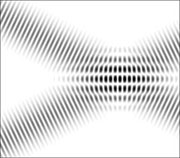 Determining the interference is simply a matter of adding the amplitudes. Consider the amplitude of the trough as a negative number. If a crest intersects with a trough, you add the amplitudes, and end up with a smaller wave. The website links mentioned above are good places to play with the possibilities that can happen when two waves meet.
