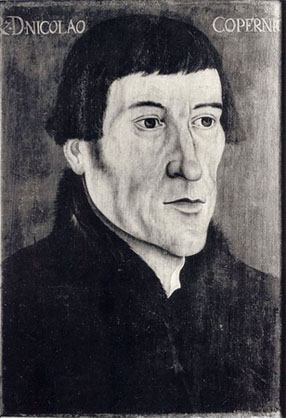
 Copernicus was born in Thorn (now Torún), Poland. His uncle, who was a bishop, arranged for Copernicus to be appointed a church canon. Copernicus was allowed to attend the University of Ferrara, in Italy, where he received his doctor’s degree. He then went on to study medicine at the University of Padua (also in Italy). He served as medical adviser to his uncle when he returned to Poland.
Fourteen hundred years before Copernicus’ time, a Greek astronomer and geographer named Ptolemy developed the theory that Earth did not move. He said the sun, moon and planets circled around Earth. Because Ptolemy’s work was so respected, for almost 1500 years astronomers believed this was true. However, Copernicus disagreed with the theory, believing his observations indicated that Earth speeds through space. He set out to prove this explanation of celestial movement. The result was his masterpiece Concerning the Revolutions of the Celestial Spheres(1543). This book demonstrated how Earth’s movements explained the movement of other heavenly bodies with the Sun as the center of the Universe.
Copernicus’ theory, now called the Copernican System, laid the foundation for Johannes Kepler to use mathematics to develop the three laws of planetary motion. In turn, Kepler’s laws were crucial to Galileo’s discoveries, based on telescopic investigation. Following the path of discovery, Sir Isaac Newton was later able to determine the principle of gravity based on the combined works of all three: Copernicus, Kepler and Galileo.
It’s easy to see why Copernicus is known as the father of modern day astronomy. His genius, curiosity, courage, and determination to rebel against what seemed to him to be false ideas, provided the foundation for all we know about astronomy.
Copernicus
Galileo
Newton
Kepler
Ptolemy |
|
