You have been told that momentum is conserved. In this activity, you can support this claim by looking at the momentum before and after the collision.
Study the first tab to learn about how momentum can affect collisions. Then, complete the case study on the second tab.
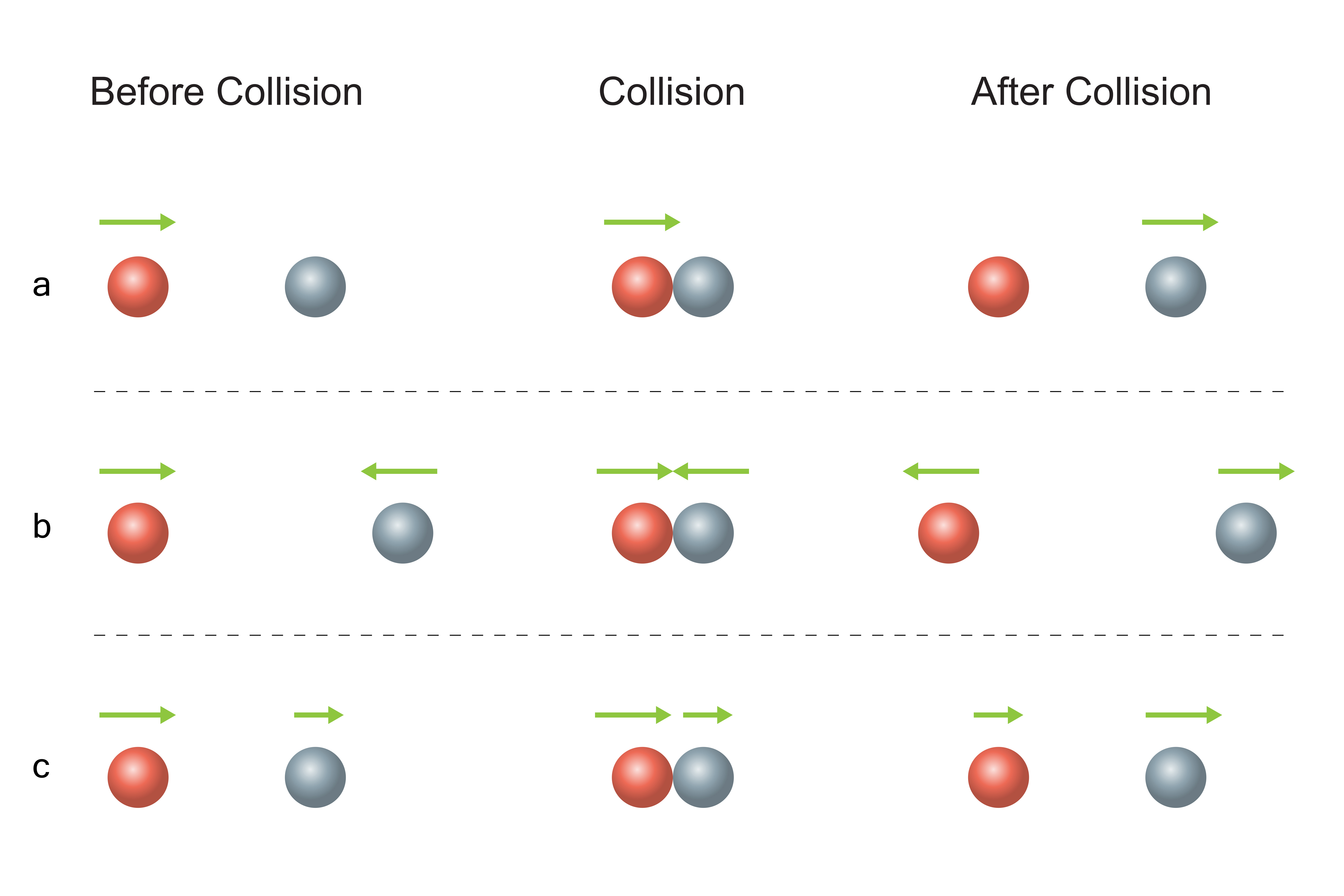
When two objects collide, they push each other. These forces can change each object's speed and direction. However, because the forces are only between the two objects, the system has no outside force.
This diagram shows three types of collisions. The length of the arrow tells you how fast the ball is moving. For example, a long arrow means the ball moves faster than a short arrow. Look at each case (a, b, c). How does the velocity change after each collision?
In case a, the energy was transferred from the first ball to the second while the velocity remained the same.
In case b, the velocity remained the same but the collision caused the balls to move in opposite directions away from each other.
In case c, the velocity of the second ball increased after it collided with the first ball.
A student makes this claim: Because there is no net force on the objects, there is no overall change in the system's momentum.
Let’s investigate this claim.
Imagine that two carts on a frictionless track collide and then stick together.
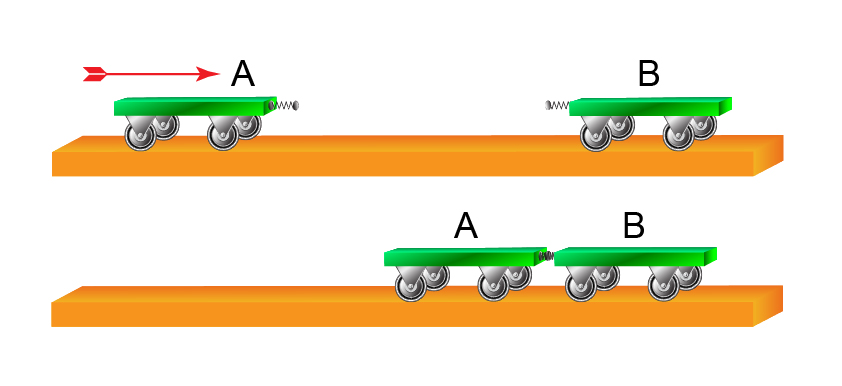
This table gives the information about the carts before the collision:
| Cart | Mass | Velocity |
|---|---|---|
| A | 0.50 kg | 1.10 m/s |
| B | 0.90 kg | 0 m/s |
After the collision, the carts stick together, and their velocity is 0.39 m/s.
Use this information to find the momentum of the carts before and after the collision. The steps are listed in the table. Read the directions in the first column and do the calculation. Then, check your answer by clicking the question.
|
Momentum = 0.50 kg x 1.10 m/s |
|
|
Momentum = 0.90 kg x 0 m/s |
|
|
Total mass = 0.50 + 0.90 = 1.40 kg |
|
|
Momentum = mass x velocity |
Question
How does the total momentum before the collision compare to the total momentum of the carts after the collision?
The momentum of cart A before the crash was 0.55 kg m/s, and it was 0 kg m/s for cart B, for a total momentum of 0.55 kg m/s. After the crash, the total momentum was calculated to be 0.55 kg m/s. Therefore, the momentum is conserved because it is the same before and after the crash when no external forces are acting on the system.
