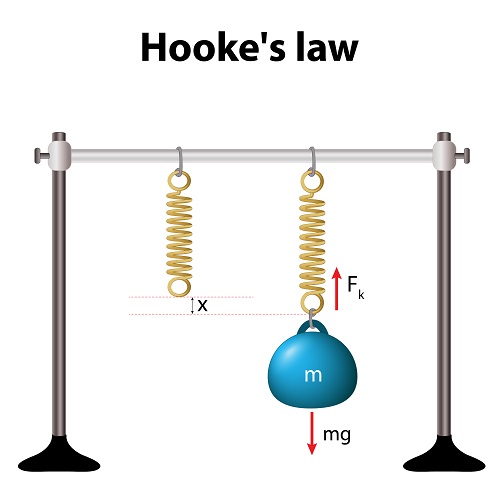
In a mass-spring system, the force provided by the spring on the object is always directed toward the equilibrium position, thus it is called the restoring force. Through experimentation, a physicist named Robert Hooke, first determined that there is a direct relationship between the restoring force and the displacement of the object from the equilibrium position. This relationship is defined using Hooke's Law, which was established in 1678.
Hooke's Law
The force needed to compress or stretch a spring is directly proportional to the displacement of the spring.
\(\large\mathsf{ F_{elastic} = -kx }\)
...where F is the spring force, k is the spring constant of the specific spring, and x is the displacement of the object from its equilibrium point. The value is negative to indicate that the force is always pointing away from the object's displacement toward the equilibrium point. *You can drop the negative sign as long as you determine the sign of the answer at the end.
So, what is the spring constant? It is a measure of a specific spring's stiffness. A larger value for k means that it takes a greater force to stretch or compress the spring. The units for k are in Newtons per meter (N/m). Let's look at an example.
A 53 N crate is attached to a spring with a spring constant of 322 N/m. How much displacement is caused by the weight of this crate?
Using Hooke's Law, we substitute in the known values and solve for displacement.
\(\mathsf{ F_{elastic} = -kx }\)
\(\mathsf{ 53 \text{ N} = -(322 \text{ N/m})x }\)
\(\mathsf{ x = -\frac{53 \text{ N}}{322 \text{ N/m}} }\)
\(\mathsf{ x = -0.16 \text{ m} }\)
Question
Suppose that the spring in the example problem was replaced and stretches 0.25 meters from its equilibrium position when the same crate is applied. What is the spring constant? Is it more or less stiff than the original spring?
For this, solve for the spring constant first.
\(\mathsf{ F_{elastic} = -kx }\)
\(\mathsf{ 53 \text{ N} = -k(-0.25 \text{ m}) }\)
\(\mathsf{ x = -\frac{53 \text{ N}}{-0.25 \text{ m}} }\)
\(\mathsf{ k = 212 \text{ N/m} }\)
This spring constant is lower than the original, so it is less stiff, which make sense because it stretched more.
