
A trapeze artist can be quite amazing to watch as they fly through the air and go between the different swings or grab on to another trapeze artist. This movement would be considered periodic motion, but would it be considered simple harmonic motion? To get to our answer, let's simplify the trapeze and make it a simple pendulum. Let's consider what we know about pendulums.
In previous studies, you have already investigated the motion of a pendulum in terms of energy. You know that the pendulum has its maximum potential energy (no velocity) at the extreme positions and the maximum kinetic energy (max velocity) at the equilibrium position. If the pendulum was at rest, it would be resting at the bottom of its semi-circular path. That "rest" position would be considered the point of equilibrium. The pendulum swings back and forth through the equilibrium position, so at least two of the requirements for simple harmonic motion are present. Let's now consider the forces—is there a restoring force that always points toward the equilibrium?
The forces acting on the mass at the end of the string come from the string and the gravitational force. We can resolve the gravitational force into two components, using the string itself as the y-axis.
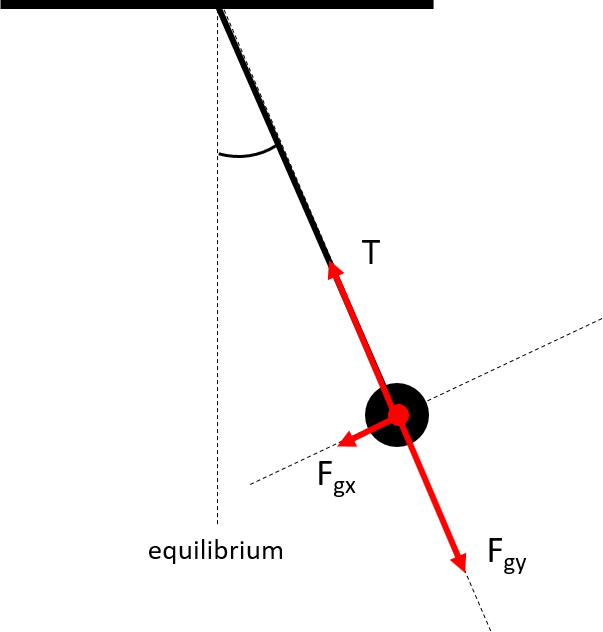
As you can see, the gravitational force in the y-direction is equal and opposite to the tension force of the string. They do not affect the motion of the mass on the pendulum. However, the gravitational force in the x-direction points toward the equilibrium point and is not balanced by another force. The restoring force of a pendulum happens to be that component of the gravitational force. As the angle increases, that component increases. As the angle decreases, that component decreases.
Question
So, is a simple pendulum representative of simple harmonic motion?
Yes! There are three requirements for simple harmonic motion and the pendulum meets these requirements:
- At the equilibrium position, the speed reaches its maximum.
- At maximum displacement (amplitude), the restoring force is greatest, and acceleration reaches maximum.
- In SHM, the restoring force is proportional to displacement.
