
Let's Investigate
In this investigation, you will determine the coefficients of static and kinetic friction. Coefficients of friction are a measure of the amount of friction existing between two surfaces.
The coefficient of static friction, \({ µs }\), is the measure of the amount of friction between two surfaces that are at rest.
The coefficient of kinetic friction, \({ µs }\), is the measure of the amount of friction between two surfaces that are moving.
By the end of this lab activity, you will be able to answer the question, “What is the relationship between the coefficients of static and kinetic friction?” using data to support your answer.
For this investigation, you will use the friction mode of the PhET simulation “Forces and Motion-Basics,” which appears below. Using this simulation, you will find the force of friction. Then, you will calculate the coefficients of static and kinetic friction using the formula. Finally, you will determine how the two coefficients compare to each other.
Once you have completed the experiment, you will communicate the results by writing a laboratory report. You will create your laboratory report in a word- processing program.
Attribution: PhET Interactive Simulations | University of Colorado | https://phet.colorado.edu
The instructions, the laboratory report requirements, and the rubric that will be used to grade the report are shown on the tabs below. Click the button below to download the instructions OR read and follow the steps on the first tab to complete the investigation.
Laboratory Instructions
Laboratory
Report
Grading
Rubric
Read and follow the directions on each slide.
|
Click the “Friction” mode of the simulation. On the screen, you will see a crate and a figure that can apply force to the crate. 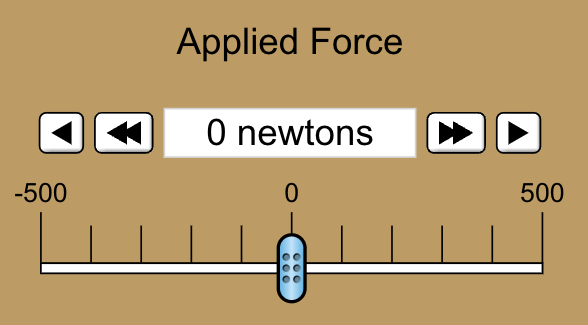
The controller for the “Applied Force” is located below the track. The applied force is set to 0 newtons. To make the figure apply a force to the crate, use the arrows on the right side of the force reading. The double arrows add 50 N at a time, and the single arrow adds 1 N at a time. 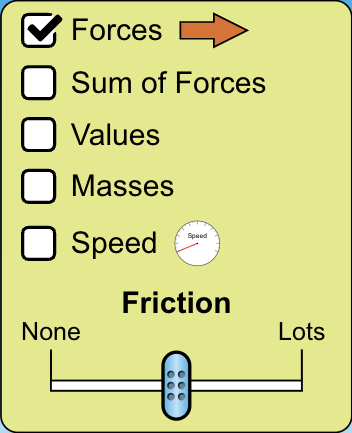
The section toward the top right side of the simulation window has various labelled areas. If “Values” is checked, the values for the forces and masses will be shown. If “Masses” is checked, the mass of each object will be shown; and if “Speed” is checked, the relative speed of the object will be shown. There is also a slider to vary the friction with a default of medium friction. “Forces” should already be selected. For this activity select “Sum of Forces,” “Values,” “Masses,” and keep the friction slider at the default value of medium friction. Make two data tables for recording information. Make one data table for the coefficient of static friction and one for the coefficient of kinetic friction. On each of these data tables, have places to record the mass, normal force, friction force, and coefficient of friction for four trials. Follow these instructions to calculate the coefficient of static friction using the simulation.
Follow these instructions to calculate the coefficient of kinetic friction using the simulation.
Add another crate on top of the first one. Calculate the new normal force based on the new mass. Record the mass and the normal force of the two crates. Repeat the procedure of pushing on the crates until they just move. Find the static friction force and the sliding friction force and record them in your data table. Use the forces to calculate the coefficient of static and kinetic friction for the two crates. Change the mass two more times by changing the objects. For each mass, record the mass and new normal forces in your data table. Find the friction forces for each and calculate and record the coefficients of static and kinetic friction. |

|

Compare the coefficient of static friction and the coefficient of kinetic friction and determine how they compare to each other. As you write your lab report, answer the question “What is the relationship between the coefficients of static and kinetic friction?”
For this experiment, you will be writing a formal laboratory report. Make sure to review the parts of a laboratory report and include each of these sections in your submission.
| Title | The title of the laboratory report tells the reader what you did in the experiment. Make it brief but include enough information to help the reader understand what was tested. |
| Introduction |
The first part of the introduction summarizes the
purpose of the experiment. This part is likely going
to be only a paragraph in length. The second part of the introduction provides a summary of the background information that is needed to understand the experiment. In other words, this is a brief report on the background research that you performed to define the problem and design the experiment. The last part of the introduction is a statement of your hypothesis. |
| Materials | This section is simply a list of the materials that are needed to perform the experiment. Remember, one of the goals of communication is to allow for another person to repeat your experiment, so be specific and thorough. |
| Procedure and Methods | This section should describe the methods and procedures used to perform the experiment. It should include a description of how to control the experiment as well as when and how to take measurements and observations. You can include a diagram of the setup if it is helpful to the reader. |
| Data | This section includes the raw data that was collected when the experiment was completed. Make sure the data is organized and presented in data tables that are easily read and understood. In this section, do not discuss the results... that comes later. |
| Analysis and Results | This is where you discuss the results of the experiment. The data section contains the raw data and this section would contain any calculations (like averages) that were made. In this section is where you interpret the data. You will refer to any figures and graphs in this section using numerical references (i.e. Figure 1, Graph 1). |
| Conclusions | The conclusion is a simple summary of what happened in the experiment. Discuss whether or not the data supported the hypothesis or not. Also, include a discussion on any unexpected error that was introduced into the experiment and how you might improve the experiment if doing it again. |
| Figures and Graphs | Use this section to display any graphs that you create from the data and analysis of the data. In the case of the paper airplane lab, a graph would include the paper weight on the x-axis and the distance flown on the y-axis as a line graph. This would show the relationship between the independent variable and the dependent variable. Make sure to label these with numbers to reference in your Analysis and Results section. This laboratory should include a graph that compares mass to acceleration. |
| References | The last thing you need to provide is any references you used for your background research. You should include at least two or three creditable resources, if not more. |
Take a look at the laboratory report rubric that will be used to grade this report. Once you have finished writing your laboratory report, turn it in to your teacher.
|
Report Components |
All required elements are present and additional elements that add to the report (e.g., thoughtful comments, graphics) have been added. |
|
Purpose |
The purpose of the lab or the question to be answered during the lab is clearly identified and stated. |
|
Background Information |
Report illustrates an accurate and thorough understanding of scientific concepts underlying the lab. |
|
Materials, Procedures |
All materials and setup used in the experiment are clearly and accurately described. |
|
Methods |
Procedures appear to be replicable. Steps are outlined sequentially and are adequately detailed. |
|
Data, Graphs, and Figures |
Professional looking and accurate representation of the data in tables and/or graphs. Graphs and tables are labeled and titled. |
|
Analysis |
The relationship between the variables is discussed and trends/patterns logically analyzed. Predictions are made about what might happen if part of the lab were changed or how the experimental design could be changed. |
|
Conclusion |
Conclusion includes whether the findings supported the hypothesis, possible sources of error, and what was learned from the experiment. |
|
References |
Several reputable background sources were used and cited correctly. Material is translated into student's own words. |
