You know that a linear equation is an equation with an independent and dependent variable. Usually the independent variable is \( x \), and the dependent variable is \( y \). You can use a linear equation, along with some substitution, to create a table of values and then use the table of values to sketch the graph of the straight line. The linear equation, its table, and its graph all represent the same information. While you can use a linear equation to create a table of values and a graph, you can also use a graph to create the related table of values and linear equation. Watch the video below to see where you might find this kind of process in your life.

Let's Watch
You can use linear equations to model many different kinds of situations.
You can find these equations in banking, shopping, and nature.
You can even find them in your own classroom!
For example, Mr. Alden is a sixth-grade social studies teacher who supervises a committee of students.
The students are planning a school-wide field trip to the natural history museum.
They need to make sure they have enough seats on the buses to transport all the students, teachers, and chaperones.
The number of buses they rent will depend on the number of people who need transportation!
You can use a linear equation to help Mr. Alden and his committee determine the number of buses needed.
In this lesson, you will learn how to use a table of values to create a linear equation, and you will help Mr. Alden and his students plan their field trip!
Question
In the video, you saw the graph that represented the relationship between the number of students and the number of buses needed to transport them. Name the coordinates of the three marked ordered pairs on this line.
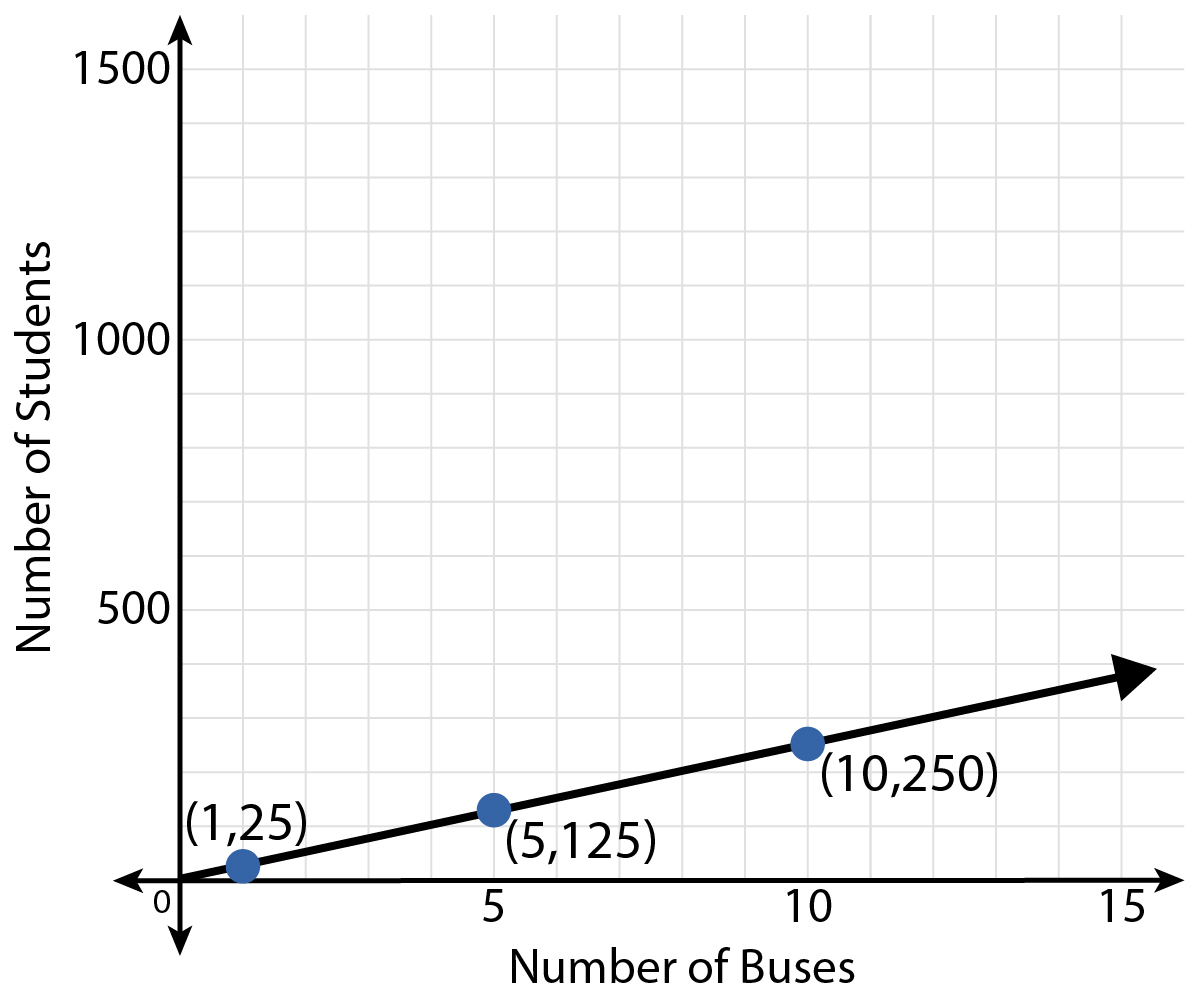
A coordinate plane with the following attributes:
- The x-axis is labeled Number of Buses.
- The y-axis is labeled Number of Students.
- The ordered pairs (1, 25), (5, 125), and (10, 250) are plotted.
- A line extends from (0, 0) through the plotted ordered pairs.
The three marked ordered pairs are \( (1,25) \), \( (5,125) \), and \( (10,250) \).
