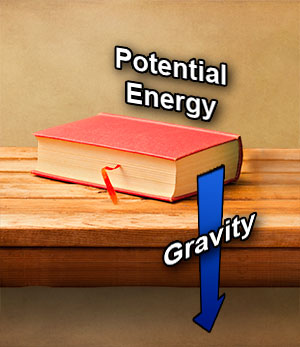
 If you have ever dropped a book, you have observed the conservation of energy. Consider a book on the edge of a table. If the table support is removed from the book, the book drops to the floor. When the book is sitting on the table, it has gravitational potential energy because it has height and mass. When the book starts to fall, all of the energy of the book is gravitational potential energy. As the book falls, the gravitational potential energy is transformed into kinetic energy. There is a small amount of energy transformed into thermal energy due to the friction between the book and the molecules in the air.
Friction is a force that opposes motion when two objects are in contact with each other. The total amount of gravitational potential energy when the book is sitting on the table is equal to the kinetic energy of the book the moment just before it hits the floor plus the thermal energy due to friction.
There is no energy destroyed when these energy transformations occur. In other words, energy is conserved. This is always true. Energy can transform from one form to another, but the total amount of energy is constant. This principle is known as the law of conservation of energy. The Law of Conservation of Energy states that energy can be transformed from one form to another, but it cannot be created or destroyed.
The Law of Conservation of Energy
How does friction impact the transformation of potential energy to kinetic energy in a falling book?
