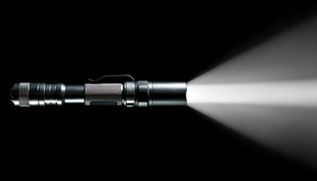
 Imagine shining a flashlight on a mirror at night. The light is reflected back at you. Does it light up the room? Probably not much. Now imagine shining the flashlight on a bookshelf in your bedroom, lighting up the bookshelf. Does it light up the room? Probably more than when you directed the light entirely at the mirror. This is because when light waves hit a reflective flat surface such as a mirror, the waves, after reflection, will travel in similar parallel waves.
 To envision this, imagine you and your friends standing in a line and throwing balls at the same angle toward a flat wall. If you could all throw them with exactly the same force each time, what would you expect to happen? They would all bounce away at the same angle; they would all travel along parallel lines.
