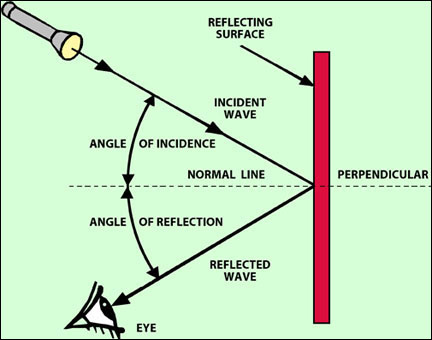
 When a ray of light hits an object, such as a flashlight ray shining on a mirror, the ray bounces off and is reflected. The ray of light that hits the mirror is called the incident ray. The ray that bounces off the mirror is called the reflected ray. The angle that the incident ray hits the mirror always determines the angle that the reflected ray leaves the mirror.
In order to envision this, imagine drawing an imaginary line perpendicular (90º) to the mirror - this is called a normal line. The normal line is always perpendicular to the object that the light is hitting. The normal line can be drawn on flat or curvy objects. It is always drawn perpendicular to the surface.
The light ray hits the mirror at a certain angle, depending on where you are standing. You can shine the light at the mirror from the side or shine the light while you are standing right in front of the mirror. The angle between the incident ray and the normal line is called the angle of incidence. The light ray is always reflected off the mirror at the same angle as the angle of incidence, only it is reflected off the other side of the normal line. The angle between the reflected ray and the normal line is called the angle of reflection. Since the angle of incidence is always the same as the angle of reflection, if we know the angle of incidence, we can figure out the angle of reflection.
Let’s say you are shining your flashlight at a mirror with an angle of incidence of 30º. The angle of reflection would be 30º.
Angle of Incidence
What is the angle of incidence?
The angle of incidence is the angle between the incident ray and the normal line.
Angles?
How can the angle of incidence and angle of reflection be compared?
Than measurement of the angle of incidence and the angle of reflection are always the same.
