You are already familiar with monatomic ions, such as Mg2+ or F-, which are formed when a single atom gains or loses electrons.
Groups of atoms can also form ions, which are referred to as polyatomic ions. The prefix “poly-” means many, so a polyatomic ion is a group of two or more atoms that behaves as a single unit, just like a tight-knit group of friends that goes everywhere together as one unit.

Keep in mind
Polyatomic ions are also known as molecular ions because the atoms involved are covalently bonded together, like in molecules. Unlike molecules which have a net charge of zero, polyatomic ions are charged species.
This chart contains a list of some of the most common polyatomic ions. Notice that all polyatomic ions are negatively charged (except for ammonium).
1− charge
hydroxide, OH−
nitrate, NO3−
nitrite, NO2−
chlorate, ClO3−
chlorite, ClO2−
2− charge
sulfate, SO42−
sulfite, SO32−
carbonate, CO32−
carbonite, CO22−
3− charge
phosphate, PO43−
phosphite, PO33−
1+ charge
ammonium, NH4+
Also notice that nearly every ion in the list has a name that ends with “-ate” or “-ite” (except for hydroxide and ammonium). The difference between the “-ate” and “-ite” versions is that the “-ite” polyatomic ions have one less oxygen atom in their formula than the “-ate” version. For example: sulfate is SO42− while sulfite is SO32−.
It is important to remember the names and formulas for common polyatomic ions. The following memory aid may help. Note that hydroxide and ammonium are not included in this aid, so you might prefer to come up with your own mnemonic device instead.
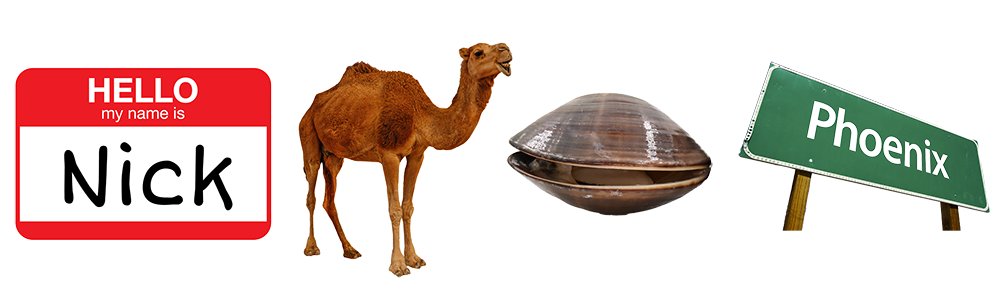
Series of images: A name tag with the name “Nick,” a camel, a clam, and a road sign for Phoenix, all used to illustrate the phrase: Nick the Camel ATE a Clam for Supper in Phoenix.
Nick the Camel ATE a Clam for Supper in Phoenix.
The phrase emphasized above can help you remember the “-ate” endings for the five main polyatomic ions. The underlined letters represent the symbols of the first element in the polyatomic ion. The number of consonants in the word represents the subscript for the oxygen in the formula. The number of vowels in the word represents the overall charge of the ion.
| Nick | Camel | Clam | Supper | Phoenix | |
|---|---|---|---|---|---|
| Underlined letter represents the first element in the ion |
nitrogen N |
carbon C |
chlorine Cl |
sulfur S |
phosphorus P |
|
# of consonants = # of oxygen atoms |
O3 | O3 | O3 | O4 | O4 |
|
# of vowels = negative charge |
1− | 2− | 1− | 2− | 3− |
|
nitrate NO3− |
carbonate CO32− |
chlorate ClO3− |
sulfate SO42− |
phosphate PO43− |
Once you have the “-ate” endings memorized, just remember that the “-ites” are “lighter.” This means each “-ite” polyatomic ion has one less oxygen atom than its corresponding “-ate” ion.
Question
Knowing the formula for chlorate is ClO3-, what is the formula for chlorite?
The formula for chlorite is one oxygen atom “lighter” than chlorate: ClO2-.
