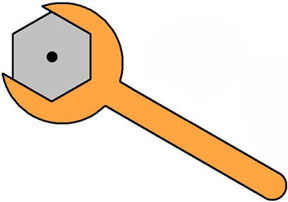
When we talk about the work being done as we apply force to the wrench, or to the outside of a wheel, we are talking about torque. Torque is commonly defined as a force that tends to rotate things. The formula for calculating torque is this:
Torque Equation
Torque = force x distance
 Sound familiar? It should! Torque actually is the work that happens as a result of the force you apply. You get more torque if you apply more force, and you also get more torque when you increase the distance, whether it be the radius of the wheel or the length of the wrench. The normal units of torque are either newton-meters (do you recognize that as a joule?) or pound-feet. These are units of work. If you look at a torque wrench, which measures the amount you are tightening a nut or bolt so that you don’t overtighten it, you’ll see these units on it.
When an effort force is applied to the circumference of a wheel, it creates a torque on the axle which turns the wheel. The amount of torque created depends, once again, on the amount of force applied and the distance. In the case of the wheel, the distance is the radius of the wheel. The direction of the force is important, too. The force applied must be perpendicular to the lever (in the case of the wrench), which is perpendicular to the radius of the wheel, for it to produce torque.
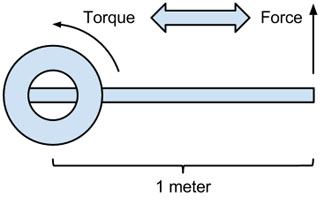 The illustration at the left shows how torque and force are equivalent at one meter leverage.
